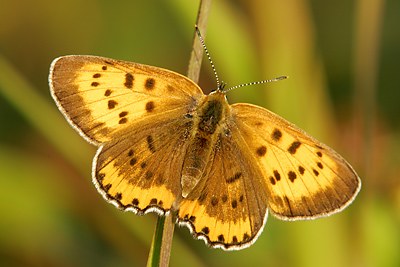
Bronze Copper
- Habitat
- Low, wet areas: bogs, marshes, wet meadows, ponds
- Size
- 1¼–1⅞ in (3.2–4.8 cm)
- Lifespan
- Adult lifespan isn't well documented for this species specifically.
- Diet
- Host: buckwheat family — curly dock. Nectar: occasional visits, documented on blackberry and red clover
About the Bronze Copper
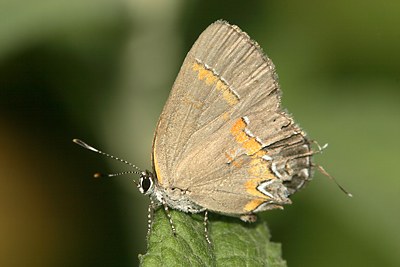
The Bronze Copper is one of the larger coppers in North America, spanning 1 1/4 to 1 5/8 inches, and shows pronounced differences between the sexes. Males have a coppery-purple sheen across the upperside of the forewing paired with a bright orange band along the hindwing margin, while females are duller, typically brown or orange with dark spots, lacking the male's iridescent shine, a difference thought to reduce how visible females are to predators while they spend time near host plants laying eggs. On the underside, both sexes show pale wings marked with dark spots and a warm orange band near the hindwing edge. Compared with the smaller, more widespread American Copper, a common dry-ground relative, the Bronze Copper is noticeably larger and restricted to wet habitat, a useful distinction where the two species' ranges might otherwise overlap along the edges of a wetland.
This species is tied closely to low, wet ground: bogs, marshes, wet meadows, and pond margins, habitats that support its host plant and keep it more localized than many of the drier-country butterflies in this group. Its distribution follows these wetland pockets fairly precisely, so it tends to appear in discrete colonies rather than continuously across the landscape, and a wetland that dries out or is drained can eliminate a local population even if suitable habitat remains nearby. Across parts of its range, ongoing loss and drainage of wetland habitat is generally considered the species' primary long-term conservation concern, since its narrow host-plant association leaves it little flexibility to shift into surrounding, drier ground.
Caterpillars feed on curly dock, a member of the buckwheat family common along wet ground, and this host relationship largely explains the butterfly's habitat preference; other dock species growing in similarly damp sites may also serve as hosts locally, though curly dock is the plant most consistently documented. Adults nectar only occasionally, with documented visits to blackberry and red clover, suggesting the species may rely less on flower nectar than many of its relatives, though observations remain limited.
Rather than patrolling widely, males of this species perch on low vegetation near stands of host plant, waiting for females to approach, a strategy that conserves energy while keeping males close to where mating opportunities are most likely to occur, and rival males that intrude on an occupied perch are typically chased off in a brief, looping aerial confrontation before the resident returns to its post. After mating, females lay their eggs singly, and the eggs themselves overwinter, hatching the following spring in time for the flush of new curly dock growth. Depending on latitude, the species may complete one or two generations per year, with populations toward the northern part of the range generally limited to a single summer brood while those farther south may fit in a second.
Because so little has been documented about adult longevity in this species specifically, much of what is known about the Bronze Copper's daily life comes from its close ties to wetland habitat and its host plant, rather than from direct behavioral studies of adult butterflies, and observers are more likely to find this species by searching stands of curly dock than by scanning flowers for nectaring adults. Within the broader copper genus, most species favor drier, sunnier ground, making the Bronze Copper's tight bond with lush wetland vegetation something of an exception among its close relatives.
Frequently asked questions
How do male and female Bronze Coppers differ in appearance?
Males show an iridescent coppery-purple sheen on the forewing, while females are duller brown or orange without that shine.
Why is this butterfly found only in certain wet spots?
Its caterpillars depend on curly dock, a wetland plant, so the species is restricted to bogs, marshes, and wet meadows where that host grows.
How do males find mates?
They perch on low vegetation near host plants and wait for females to come to them rather than actively patrolling.
How does the Bronze Copper get through winter?
It overwinters in the egg stage, with eggs hatching the following spring.
How does the Bronze Copper compare to the more common American Copper?
The Bronze Copper is noticeably larger and restricted to wet meadows and marsh edges, while the American Copper is smaller and found in a much wider range of dry, open habitats.
Where to find it
This species favors wetland habitat. See real Oklahoma locations on the Habitats map.