Olympia Marble
- Habitat
- Open areas: prairies, foothills, lakeshore dunes, shale barrens, meadows, open woodlands
- Size
- 1⅜–2 in (3.5–5.1 cm)
- Lifespan
- Adults fly for just a few weeks each spring; nearly all its life is spent as an overwintering chrysalis.
- Diet
- Host: rock cresses (mustard family). Nectar: rock cress flowers, chickweed, phlox, houstonia
About the Olympia Marble
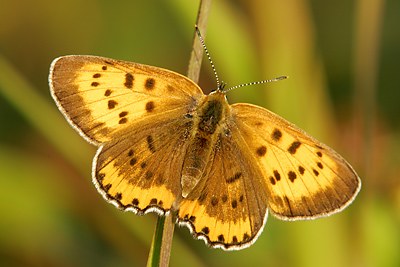
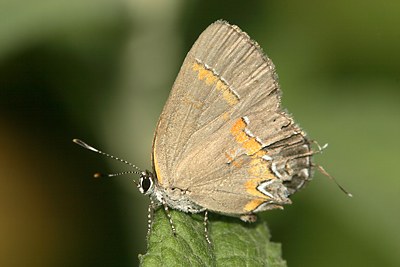
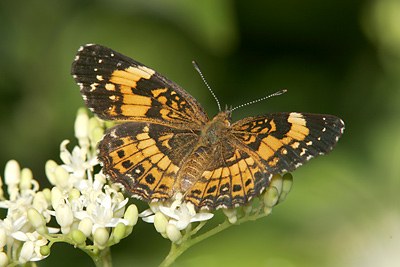
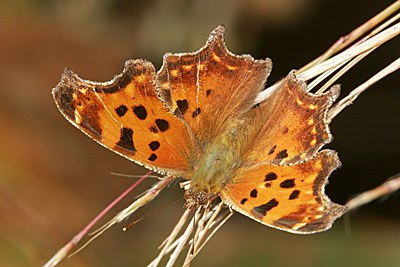
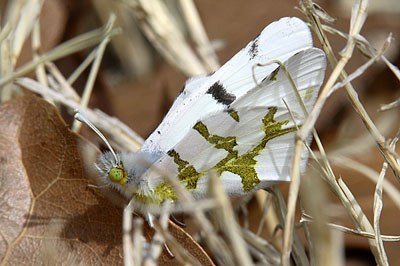
The Olympia Marble is a small, delicate white butterfly best identified by the mottled olive-green "marbling" on the underside of its hindwings, a pattern that breaks up its outline against the spring foliage it rests on. The upperside is mostly plain white, with dark-tipped forewings and, in some individuals, a faint wash of pink or orange scaling near the tip. At just 1⅜ to 2 inches across, it is easy to overlook, and its brief flight period means many people never encounter it at all. It belongs to a small group of whites known as the marbles, all sharing this same underwing strategy of breaking up their outline with irregular blocks of color rather than relying on speed or bright warning patterns to avoid predators.
This species favors open, sun-exposed ground: prairies, rolling foothills, sandy lakeshore dunes around the Great Lakes, exposed shale barrens in the Appalachians, and open woodland edges. Its patchy distribution reflects the scattered availability of its host plants rather than any single preferred region, and it is generally considered uncommon to locally common depending on habitat quality. Because it needs specific, often thin or rocky soils to support its host plants, entire regional populations can be separated from one another by many miles of unsuitable ground.
Caterpillars feed exclusively on rock cresses in the mustard family, and rather than eating leaves like most butterfly larvae, they specialize on the plant's flowers, buds, and developing seed pods. Adults nectar at the same rock cress blossoms as well as chickweed, phlox, and bluets (Houstonia), sipping just enough to fuel a short, intense mating season. Males stake out hilltops and high points, a mate-locating strategy called hilltopping, and wait for females to pass through rather than searching the landscape themselves.
The Olympia Marble's life history is a study in economy of effort: females lay their eggs singly, one to a flower bud, and the resulting caterpillars develop quickly before pupating. The chrysalis is where this species spends the overwhelming majority of its life, sometimes the better part of a year, sealed in dormancy through summer, fall, and winter until conditions are right the following spring. Adults themselves fly for only a few weeks, a fleeting window built entirely around the flowering of their host plants, making early spring the only realistic time to find this butterfly on the wing. This species produces just a single generation each year, a life-cycle pattern known as univoltine, in contrast to many of the sulphurs and blues that squeeze several broods into the same warm season.
Frequently asked questions
Why is it called a "marble" butterfly?
The underside of its hindwings shows a mottled olive-green marbling pattern that camouflages it among vegetation, which is where the common name comes from.
When can you actually see an Olympia Marble flying?
Only for a few weeks in early spring, since adults emerge briefly to mate and lay eggs before the next generation spends most of the year as a chrysalis.
What do the caterpillars eat?
They feed on the flowers and developing seed pods of rock cresses rather than on the plant's leaves.
How do males find females to mate with?
Males practice hilltopping, perching on hilltops or high ground and waiting for females to fly past rather than searching the countryside themselves.
Where to find it
This species favors wetland habitat. See real Oklahoma locations on the Habitats map.