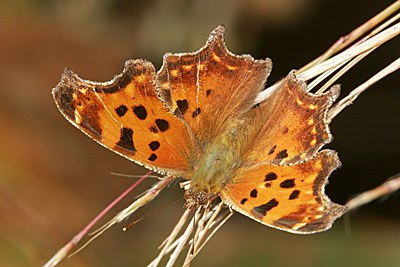
Eastern Comma
- Habitat
- Deciduous woodlands; woods near rivers, marshes, swamps, water sources
- Size
- 1¾–2½ in (4.5–6.4 cm)
- Lifespan
- Also overwinters as an adult like its close relative the Question Mark, surviving several months.
- Diet
- Caterpillar: elm and nettle families — American elm, hops, nettle, false nettle, wood nettle. Adult: rotting fruit and tree sap
About the Eastern Comma
The Eastern Comma (Polygonia comma) is a medium to large anglewing butterfly, spanning 1¾ to 2½ inches (4.5–6.4 cm) across the wings — somewhat smaller than its close relative the Question Mark but sharing the same ragged, scalloped wing outline. The upper wings are orange with dark spotting, while the underside is a mottled brown that mimics a dead leaf, excellent camouflage for a butterfly that spends long stretches at rest on tree bark or leaf litter. Its name comes from a small, silver comma-shaped mark tucked on the underside of the hindwing, the counterpart to the Question Mark's more elaborate punctuation-shaped mark.
Eastern Commas are creatures of deciduous woodland, especially the moister corners of it — woods bordering rivers, marshes, swamps, and other water sources. Caterpillars feed on plants from the elm and nettle families: American elm, hops, nettle, false nettle, and wood nettle all serve as hosts, generally in the shadier, damper woodland settings where these plants thrive. Adults, much like Question Marks, largely skip flowers in favor of rotting fruit and tree sap, feeding on these richer, more concentrated food sources whenever available.
The species produces two broods a year, and its seasonal pattern is closely tied to overwintering as an adult rather than as an egg, caterpillar, or chrysalis. Adults that survived the winter emerge and fly into April, mating and laying eggs to produce the summer generation. That summer form then flies from May through September, followed by a distinct winter form that emerges and flies from September into October before tucking into sheltered bark crevices or similar refuges to wait out the cold.
This overlapping cycle of overwintering adults, summer fliers, and winter fliers means Eastern Commas can be seen on the wing across most of the growing season, with only brief lulls between generations. Like the Question Mark, this adult overwintering strategy allows individual Eastern Commas to survive for several months — a notably long lifespan for a butterfly, and a major reason the species can appear so early in spring, often before most other butterflies have emerged.
Eastern Commas range across most of the eastern United States and adjacent Canada, generally favoring cooler, shadier woodland than some of their anglewing relatives. Like the Question Mark, individual butterflies show seasonal color forms, with the darker winter form better matching the bare branches and leaf litter of the cold months when it must remain hidden for long stretches at a time.
Frequently asked questions
How is the Eastern Comma different from the Question Mark?
It's somewhat smaller, has a simpler comma-shaped silver mark on the hindwing underside rather than the Question Mark's dot-and-curve, and favors deciduous woodland near water rather than open, park-like settings.
How many broods does the Eastern Comma produce each year?
Two broods a year, with a summer form flying May through September and a winter form flying September through October.
How does the Eastern Comma survive winter?
It overwinters as an adult, sheltering in bark crevices and similar refuges, and emerges to fly again as early as spring.
What do Eastern Comma caterpillars eat?
They feed on elm and nettle family plants, including American elm, hops, nettle, false nettle, and wood nettle.
Where to find it
This species favors wetland habitat. See real Oklahoma locations on the Habitats map.