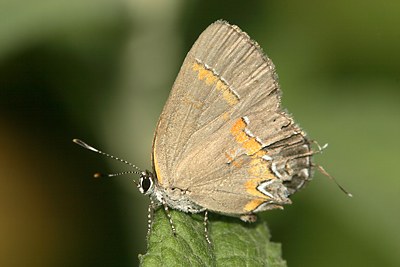
Red-banded Hairstreak
- Habitat
- Coastal hammocks, overgrown fields, forest edges
- Size
- 7/8–1¼ in (2.2–3.2 cm)
- Lifespan
- Adults typically live 1 to 2 weeks after emerging.
- Diet
- Host: fallen leaves of wax myrtle, dwarf sumac, staghorn sumac, various oaks. Nectar: yarrow, wild cherry, tickseed sunflower, sumac, sweet pepperbush, New Jersey tea, common milkweed, dogbane
About the Red-banded Hairstreak
The Red-banded Hairstreak is a small brown hairstreak, ⅞ to 1¼ inches across, marked by a reddish-orange postmedian band edged in white across the underside of the hindwing, along with a small patch of blue near the tail and a fine black-and-white checkered fringe along the wing margins. Compared to some of the more subtly marked hairstreaks in this group, its warm-colored banding makes it relatively easy to identify at rest, especially against the grayer, more subtly patterned hairstreaks it shares habitat with. Like most hairstreaks, it carries a pair of thin, hair-like tails on each hindwing next to a false eyespot, and perched individuals often rub their hindwings together in a slow, scissoring motion that makes the tails wiggle like a second pair of antennae; the resulting illusion of a "false head" at the wing's trailing edge is thought to redirect a bird's or lizard's exploratory strike toward an expendable bit of wing margin rather than the true head and body.
This species occurs in coastal hammocks, overgrown fields, and forest edges, largely across the southeastern United States, where its host plants and the leaf litter it depends on are readily available. Its range and abundance track fairly closely with the availability of wax myrtle and various sumacs and oaks growing in these habitats, and it is generally most numerous close to the coast where wax myrtle thickets are dense. In recent decades the species has also turned up with some regularity in suburban gardens well inland, likely helped along by the popularity of wax myrtle as an ornamental hedge plant, which has effectively extended patches of suitable habitat into yards and landscaped lots far from any natural hammock.
What makes the Red-banded Hairstreak especially notable is its host substrate: rather than laying eggs on live, growing leaves as most hairstreaks do, females deposit eggs singly on fallen leaves of wax myrtle, dwarf sumac, staghorn sumac, and various oaks. The caterpillars then feed on this decaying leaf litter rather than fresh foliage, an unusual larval habit among North American butterflies that ties the species closely to the leaf-drop cycle of its host plants. This detritivore-like niche is unusual enough among the otherwise leaf-chewing Lycaenidae that it likely offers the caterpillars a measure of protection from parasitoid wasps and flies that key in on fresh green growth to find their hosts, since a search of dry litter is a very different task from scanning live foliage. Adults, in contrast, nectar at a broad range of flowers, including yarrow, wild cherry, tickseed sunflower, sumac, sweet pepperbush, New Jersey tea, common milkweed, and dogbane.
Males perch on shrubs and low trees, watching for passing females much like other hairstreaks in this group, and will dart out to investigate anything moving through their territory before returning to the same twig. Adults typically live only one to two weeks after emerging, but because the species breeds continuously through the warm months across its southeastern range, multiple overlapping generations can pass through in a single year, and in the mildest parts of Florida adults may be found on the wing in almost any month. Farther inland and to the north, flight activity contracts to a warm-season window running roughly from spring through fall.
The reliance on fallen leaves near host plants for egg-laying is one of the more distinctive life-history quirks among the hairstreaks profiled here, setting it apart from tree-canopy specialists like the Banded Hairstreak or Great Purple Hairstreak, and making a search of the leaf litter directly beneath a host shrub a more productive way to find eggs or young caterpillars than scanning the foliage above. Because that litter layer is so central to the species' survival, aggressive yard cleanup that strips fallen leaves from beneath ornamental wax myrtle and sumac can quietly remove an entire generation's nursery, a detail gardeners hoping to host the species are often unaware of.
Frequently asked questions
What is unusual about where this butterfly lays its eggs?
Females lay eggs singly on fallen, dead leaves beneath host plants rather than on live foliage, an unusual habit among hairstreaks.
What do the caterpillars eat?
They feed on decaying fallen leaves of wax myrtle, sumacs, and oaks rather than fresh green foliage.
How long do adults typically live?
Usually about one to two weeks after emerging.
Where is the Red-banded Hairstreak most commonly found?
In coastal hammocks, overgrown fields, and forest edges across the southeastern United States.
What is the "false head" trick this butterfly uses?
By rubbing its hindwings together at rest, it makes the thin tails wiggle like antennae near a false eyespot, drawing a predator's strike toward the wing margin instead of the real head.
Where to find it
This species favors wetland habitat. See real Oklahoma locations on the Habitats map.