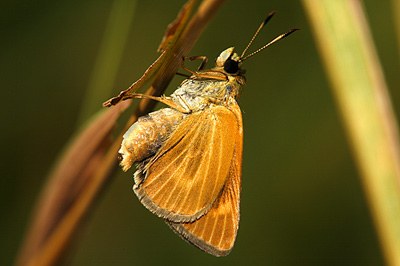
Byssus Skipper
- Habitat
- Tall-grass prairie (Midwest), coastal marsh edges (Atlantic Coast)
- Size
- 1 7/16–1 13/16 in (3.7–4.6 cm)
- Lifespan
- Lifespan specifics aren't documented; assume a short adult life of roughly two to three weeks.
- Diet
- Caterpillar: eastern grama grass. Adult: pickerelweed
About the Byssus Skipper
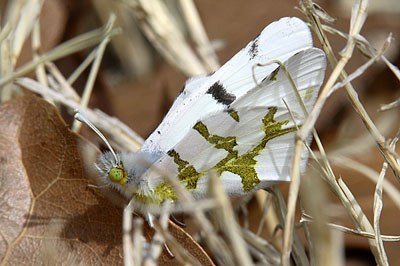
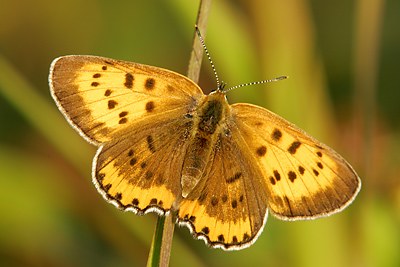
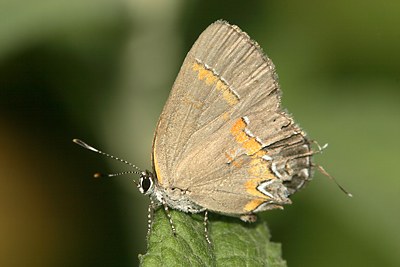
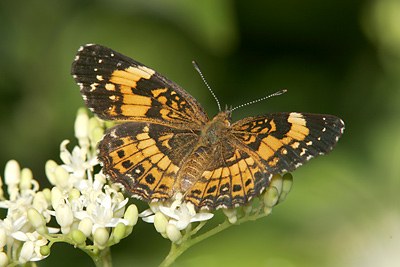
The Byssus Skipper is a medium-sized skipper, spanning roughly 1 7/16 to 1 13/16 inches (3.7-4.6 cm) across the wings. Like most grass-skippers, it holds its wings in the characteristic 'jet-fighter' posture at rest -- forewings raised at a steep angle while the hindwings lie flat -- a stance thought to aid basking and quick thermoregulation before flight. The upperside is a bright yellow-orange, bordered in black, with a distinctive black bar crossing the wing cell; females are noticeably darker overall, a common pattern in skippers where females carry heavier melanic markings, possibly for added camouflage while ovipositing low in dense grass. The overall effect in flight is a flash of orange against green, though the species can be easily overlooked among other grass-skippers without a close look at the cell bar, and its flight itself is typical of the group: fast, low, and direct, with the butterfly often dropping abruptly into cover rather than circling to land.
This species occupies two quite different landscapes: tall-grass prairie remnants across the Midwest, and coastal marsh edges along the Atlantic Coast. This split range reflects the availability of its host grass rather than a single preferred climate, and it suggests the species tracks specific grassland structure -- dense stands of tall, coarse grasses -- more than any particular soil or moisture regime. Where prairie has been converted to row-crop agriculture, populations are likely restricted to surviving remnants, roadsides, and protected preserves, and because so little unplowed tallgrass prairie remains across much of the historic Midwestern range, the species is generally considered uncommon to locally rare over large parts of its inland distribution, even where it was likely once more continuously distributed.
Caterpillars feed on eastern grama grass, a native grass associated with undisturbed or lightly managed prairie. Like many grass-feeding skipper larvae, byssus caterpillars build shelters by rolling or tying a blade of the host grass with silk, feeding from within this retreat and venturing out mainly at night or in the shelter's cover, a strategy that limits exposure to predators and desiccation. Adults nectar at pickerelweed, a wetland plant, which helps explain the coastal-marsh populations' proximity to standing water even though the caterpillars still require grass rather than aquatic vegetation; inland prairie populations likely draw on a broader range of native prairie wildflowers for nectar, though pickerelweed itself is generally restricted to the wetter, coastal part of the range.
Byssus Skipper caterpillars overwinter as fourth-instar larvae, tucked inside their leaf shelters through the cold months, then resume feeding and complete development the following season. Pupation takes place in a silk cocoon spun within the leaf litter at the base of the host plant, rather than on the grass blade itself, offering the pupa some insulation and protection from surface exposure. The species is generally single-brooded across most of its range, with adults on the wing for a relatively brief window in summer, a pattern consistent with its reliance on a single generation of caterpillars completing development before winter sets in.
Adult lifespan isn't specifically documented for this species, but a short flight span of roughly two to three weeks is typical of adult skippers generally, consistent with a life history built around rapid mating and egg-laying rather than longevity. Because both its coastal marsh and inland prairie habitats have been substantially reduced by development and agriculture, the Byssus Skipper is often cited as an example of a grassland specialist whose fortunes are closely tied to the fate of increasingly fragmented natural grass communities.
Frequently asked questions
What color is the Byssus Skipper?
Bright yellow-orange above with black borders and a black cell bar; females are darker overall.
Where does the Byssus Skipper live?
Tall-grass prairie in the Midwest and coastal marsh edges along the Atlantic Coast.
What do Byssus Skipper caterpillars eat?
Eastern grama grass; adults nectar mainly at pickerelweed.
How does the Byssus Skipper overwinter?
As fourth-instar caterpillars inside rolled leaf shelters, later pupating in silk cocoons within leaf litter.
Why is the Byssus Skipper considered uncommon in parts of its range?
Much of the unplowed tallgrass prairie it depends on in the Midwest has been converted to agriculture, leaving populations restricted to scattered remnants, roadsides, and protected preserves.
Where to find it
This species favors wetland habitat. See real Oklahoma locations on the Habitats map.