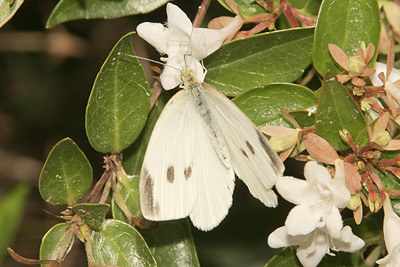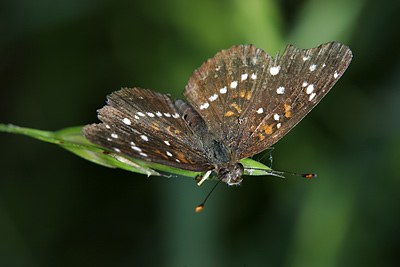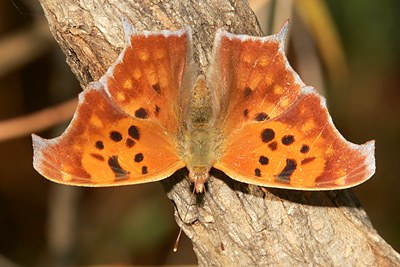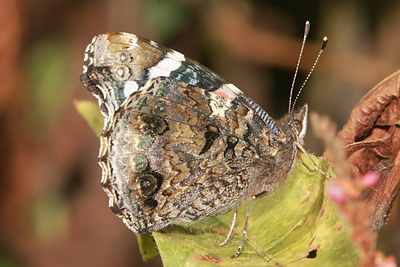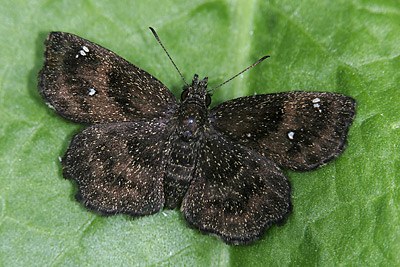
Hayhurst's Scallopwing
- Habitat
- Roads, trails, woodland openings, weedy vacant lots, suburban gardens
- Size
- 1–1 1/4 in (2.5–3.2 cm)
- Lifespan
- Lifespan data is lacking; small skippers like this one usually live under two weeks.
- Diet
- Caterpillar: lambsquarters, occasionally chaff flower. Adult: marigold, knotweed, spearmint, marjoram, cucumber, dogbane, sweet clover, white clover
About the Hayhurst's Scallopwing
Hayhurst's Scallopwing is one of the smallest skippers observers are likely to encounter, spanning only about 1 to 1 1/4 inches across the wings. Its most distinctive feature is visible along the wing margins: rather than the smooth or gently uneven edges typical of many skippers, this species' wings are noticeably scalloped, curving in and out in a shallow wave pattern, and bordered by a checkered fringe that alternates between light and dark segments. The body and wings are otherwise a subdued mottled brown-black, an unassuming coloration that blends well against bare soil, gravel, and weedy leaf litter. Like other skippers, it likely holds its wings in the family's characteristic basking posture, forewings raised at an angle above more flatly spread hindwings, when warming itself in open sun.
This species favors open, disturbed, and human-altered ground rather than pristine natural habitat: roadsides, trails, woodland openings, weedy vacant lots, and suburban gardens all provide suitable conditions. This tolerance for disturbed terrain makes it one of the skippers most likely to turn up close to houses and along well-traveled paths, since its host and nectar plants are common weeds of cultivated and neglected ground alike. Because it tolerates mowed lots, gravel lots, and cultivated gardens equally well, it is a species that butterfly-watchers may encounter even in heavily developed areas, not just in wilder habitat.
Caterpillars feed primarily on lambsquarters, a widespread weedy plant, and occasionally on chaff flower, reflecting a diet built around common disturbed-ground forbs rather than grasses or specialized native plants. Adults are generalist nectar feeders, visiting marigold, knotweed, spearmint, marjoram, cucumber, dogbane, sweet clover, and white clover, many of which are themselves plants of gardens, field margins, and roadsides, so the adult's feeding range mirrors the same weedy, human-influenced landscape used by the caterpillar.
Caterpillars of this species are nocturnal feeders, a common strategy among small skippers that reduces exposure to day-active predators and parasitoids. During daylight hours the larvae shelter inside a rolled or folded leaf of the host plant, held closed with silk, emerging after dark to feed and retreating again before dawn. Third-stage caterpillars carry this sheltering behavior through the winter, constructing a silk-lined leaf shelter in which to overwinter before resuming development and eventually pupating the following season. Specific lifespan data for the adult stage is lacking, but small skippers of this kind typically live under two weeks, consistent with a life history built around rapid turnover between generations rather than long-lived individual adults.
Frequently asked questions
What does the name "Scallopwing" refer to?
It describes the wing margins, which curve in and out in a scalloped pattern and are bordered by a checkered fringe, rather than having smooth edges.
Where is Hayhurst's Scallopwing typically found?
In open, disturbed ground such as roads, trails, woodland openings, weedy vacant lots, and suburban gardens.
What do the caterpillars eat, and how do they behave?
They feed mainly on lambsquarters (occasionally chaff flower) and shelter inside rolled leaves by day, coming out to feed at night.
How does this species survive the winter?
Third-stage caterpillars overwinter inside silk-lined leaf shelters, resuming development the following season.
Where to find it
This species favors city / backyard habitat. See real Oklahoma locations on the Habitats map.