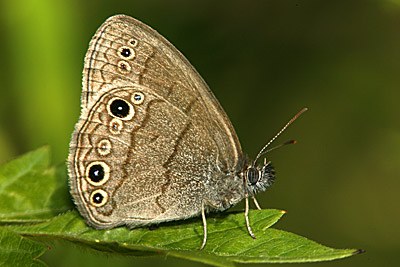
Carolina Satyr
- Habitat
- Grassy places and woodlands
- Size
- 1¼–1½ in (3.2–3.8 cm)
- Lifespan
- Adults likely live one to two weeks, though precise data for this species is limited.
- Diet
- Caterpillar: carpet grass, centipede grass; possibly St. Augustine grass, Kentucky bluegrass. Adult: sap and rotting fruit
About the Carolina Satyr
The Carolina Satyr is a small, plainly colored butterfly, measuring just 1 1/4 to 1 1/2 inches across, with soft brown wings set with a row of small, dark eyespots on both the forewings and hindwings. There is little bold pattern here; instead, the species relies on its muted tones and understated markings to stay inconspicuous within the grassy, shaded settings it calls home, making careful observation of flight style and eyespot arrangement the best way to confirm an identification. Recent genetic work on the genus has revealed that what was long treated as a single, wide-ranging Carolina Satyr may actually represent more than one closely related, visually near-identical species across its range, a reminder that some small, drab satyrs are more taxonomically complicated than their plain appearance would suggest.
Carolina Satyrs are found in grassy places and woodlands, favoring the transition zones between open turf and shaded tree cover. This adaptability to mowed and semi-wild grassy habitats, including lawns, parks, and woodland edges, has made the species one of the more frequently encountered satyrs across its range, even in areas with substantial human development, so long as suitable host grasses are present. The butterfly generally avoids open, hot, direct sun, instead favoring dappled or filtered light beneath a partial tree canopy, and it becomes noticeably less active during the hottest part of a summer day, resuming activity as temperatures ease toward evening.
True to its family's understory habits, the Carolina Satyr flies slowly and weakly, rarely straying far from ground level and staying mostly within the shade of the forest understory rather than crossing open, sunlit spaces; its flight has a characteristic bouncing, erratic quality, low to the ground and easily lost from view the moment the butterfly settles back into leaf litter or grass. Males patrol during the day, cruising low over grass in search of females rather than perching to wait for them, a foraging-flight strategy that keeps them moving through their habitat throughout daylight hours.
Caterpillars feed on carpet grass and centipede grass, and are thought to also use St. Augustine grass and Kentucky bluegrass, all common lawn and pasture grasses that put this species in regular contact with residential and agricultural landscapes. Adults do not visit flowers for nectar; instead they feed on tree sap and rotting fruit, extracting sugars from these decaying sources rather than from blossoms, and they will also occasionally visit damp soil or mud, drawing moisture and dissolved minerals in the same manner documented in many other butterflies. As with many small satyrs, precise longevity data is limited, but adults are thought to live only about one to two weeks, meaning that a given local population is refreshed by new emergences many times across a single warm season.
Carolina Satyrs range through the southeastern United States, and in the warmest parts of that range, such as Florida and the Gulf Coast, they can be seen flying in nearly every month of the year thanks to several overlapping broods. They are frequently confused with the similar Gemmed Satyr, which favors similar shaded, grassy habitat and often flies alongside it, though the Carolina Satyr typically shows an additional small eyespot on the hindwing that the Gemmed Satyr lacks. Because it rarely strays far from sheltering vegetation, a single favorable patch of shaded lawn or woodland edge can support a resident colony for years, largely unnoticed by anyone not specifically looking for small brown butterflies low in the grass.
Frequently asked questions
Where does the Carolina Satyr live?
Grassy places and woodlands, especially shaded understory areas near grassy edges.
What grasses do Carolina Satyr caterpillars feed on?
Carpet grass and centipede grass, and possibly St. Augustine grass or Kentucky bluegrass.
How does the Carolina Satyr fly compared to other butterflies?
It flies slowly and weakly, staying low in the forest understory rather than crossing open, sunlit ground.
What do adult Carolina Satyrs eat?
Sap and rotting fruit rather than flower nectar.
Is the "Carolina Satyr" actually just one species?
Recent genetic research suggests the butterflies long called Carolina Satyr may include more than one closely related, nearly identical species, though this remains an active area of study.
Where to find it
This species favors forest habitat. See real Oklahoma locations on the Habitats map.