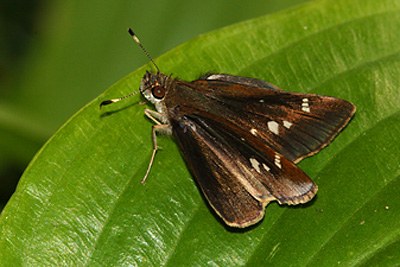
Clouded Skipper
- Habitat
- Forest edges/clearings near rivers and swamps
- Size
- 1 1/4–1 3/4 in (3.2–4.5 cm)
- Lifespan
- Adult lifespan hasn't been specifically studied; expect a short multi-week span typical of grass skippers.
- Diet
- Caterpillar: grasses — St. Augustine, wooly beard grass. Adult: pink/purple/white flowers — shepherd's needle, selfheal, vervain, buttonbush, lantana
About the Clouded Skipper
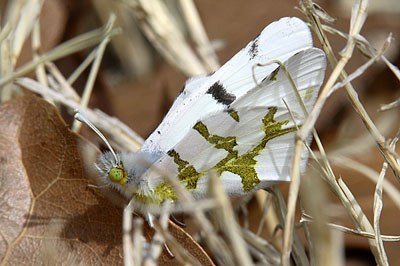
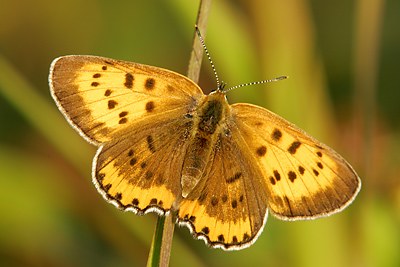
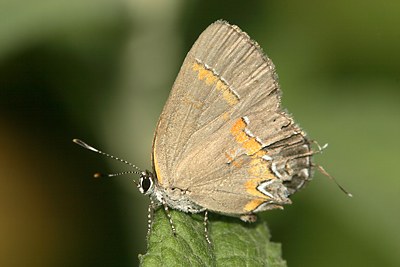
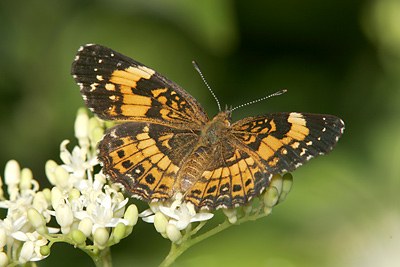
The Clouded Skipper is a modestly sized butterfly, spanning roughly 1 1/4 to 1 3/4 inches (3.2 to 4.5 cm) across the wings, which places it comfortably in the middle range for grass skippers. Like other members of the skipper family, it holds its wings in the characteristic "jet-plane" posture at rest, with the forewings angled upward and the hindwings spread flatter below them, an arrangement thought to aid both camouflage and quick thermoregulation. The most reliable field mark separates the sexes: males carry a dark black stigma, a patch of specialized scent scales on the forewing used to disperse pheromones during courtship, while females lack this structure entirely and instead show small transparent white spots in roughly the same area. On the underside of the hindwing, both sexes display a mix of dark and light patches overlaid with a subtle violet-blue sheen, an iridescent effect produced by the microscopic structure of the wing scales rather than pigment alone, and this sheen can appear stronger or fainter depending on the angle of light.
Clouded Skippers favor forest edges and clearings near rivers and swamps, the kind of transitional zone where woodland gives way to open, sunlit vegetation. This edge habitat supplies both the grasses larvae depend on and the flowering plants adults need for nectar, while the nearby water sources likely help maintain the humidity many grass-feeding skippers seem to prefer. Within Oklahoma and the broader range, expect to find this species patrolling low over such semi-open, moisture-adjacent ground rather than deep forest interior or fully open prairie.
Caterpillars feed on grasses, including St. Augustine grass and wooly beard grass, a diet typical of the Hesperiinae subfamily, many of whose larvae specialize on lawn and turf grasses and construct silk-tied leaf shelters while feeding. Adults nectar at a range of pink, purple, and white flowers, among them shepherd's needle, selfheal, vervain, buttonbush, and lantana, clinging to the flower head with wings often held partly open while the long proboscis uncoils to probe individual florets, a feeding posture typical of skippers generally.
No study has specifically measured Clouded Skipper adult lifespan, but a short multi-week span is the expectation for grass skippers generally, consistent with a life cycle built around rapid turnover across a warm season. As with related species, the larval stage likely does the bulk of the surviving-the-lean-months work, sheltering within tied or rolled grass blades that offer both camouflage and some protection from predators and weather.
Frequently asked questions
How can you tell male and female Clouded Skippers apart?
Males have a dark black stigma (a scent-scale patch) on the forewing, while females lack it and show small transparent white spots in the same area instead.
Where does the Clouded Skipper live?
It favors forest edges and clearings near rivers and swamps, where woodland transitions into open, sunlit vegetation.
What do Clouded Skipper caterpillars eat?
The caterpillars feed on grasses such as St. Augustine grass and wooly beard grass.
What flowers do adult Clouded Skippers visit for nectar?
Adults nectar at pink, purple, and white flowers including shepherd's needle, selfheal, vervain, buttonbush, and lantana.
Where to find it
This species favors wetland habitat. See real Oklahoma locations on the Habitats map.