Common Buckeye
- Habitat
- Open, sunny areas with low vegetation and some bare ground
- Size
- 1⅝–2¾ in (4.2–7 cm)
- Lifespan
- Adults typically live about 2 to 3 weeks; the fall generation migrates south instead of overwintering here.
- Diet
- Caterpillar: snapdragon family, plantain family, ruellia. Adult: favorite nectar sources are composites — aster, chicory, gumweed, knapweed, tickseed sunflower; also dogbane, peppermint
About the Common Buckeye
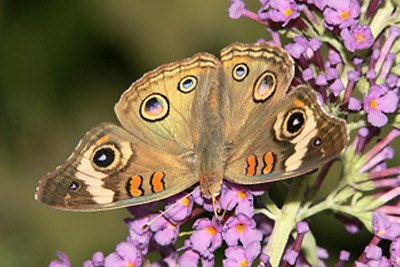
The Common Buckeye (Junonia coenia) is one of the most instantly recognizable North American butterflies thanks to its bold eyespot pattern, spanning 1⅝ to 2¾ inches across brown wings. Each hindwing carries two large, staring eyespots in concentric rings of black, blue, and orange, with a smaller pair echoed on the forewing, and two pale orange bars cross the forewing near its base. This dramatic pattern is thought to startle or misdirect predators away from the vulnerable body.
Buckeyes favor open, sunny habitats with low vegetation and patches of bare ground, including fields, roadsides, gardens, and dry disturbed areas, where they often bask with wings spread flat to soak up warmth. The species ranges across most of the United States and into Mexico, with populations expanding northward each summer before retreating south again.
Caterpillars feed on plants in the snapdragon and plantain families, along with ruellia, chewing on foliage of low-growing hosts common in open ground. Adults are strongly drawn to composite flowers, with aster, chicory, gumweed, knapweed, and tickseed sunflower among their favorite nectar sources, along with dogbane and peppermint. Females lay their eggs singly rather than in clusters, and the resulting caterpillars are solitary feeders that do not build communal nests.
Male Common Buckeyes take up perches on low plants or patches of bare ground, watching from a favored spot for passing females rather than patrolling widely. Adults live only about two to three weeks, and because the species cannot survive freezing winters in much of its range, the fall generation instead migrates south rather than attempting to overwinter locally, with numbers rebuilding again from southern populations the following year.
The species also shows seasonal variation in color: individuals from the cooler, shorter days of fall frequently develop a rosier, more reddish-brown wash across the hindwing compared to the more olive-brown summer form, a temperature-triggered effect seen in several butterfly species. Multiple broods occur each year across the warm months, with populations building steadily from spring into late summer and occasionally expanding well north of their normal breeding range before the southward retreat begins.
Common Buckeyes are strong, direct fliers for their size, and their fondness for open bare ground makes them a familiar sight along dirt paths and roadsides where they bask and watch for rivals or mates. The species is not considered a true year-round resident across most of its range, which is part of why sightings farther north tend to build steadily as summer progresses.
Frequently asked questions
Why does the Common Buckeye have such large eyespots?
The bold, staring eyespots are thought to startle predators or draw a strike away from the butterfly's vulnerable body.
What plants do Common Buckeye caterpillars feed on?
They feed on plants in the snapdragon and plantain families, as well as ruellia.
Do Common Buckeyes overwinter in the north?
No, the fall generation migrates south instead of trying to survive freezing winters where it isn't equipped to overwinter.
Where do Common Buckeyes like to perch?
Males favor low plants or bare ground in sunny, open areas, where they wait and watch for passing females.
Where to find it
This species favors grassland habitat. See real Oklahoma locations on the Habitats map.