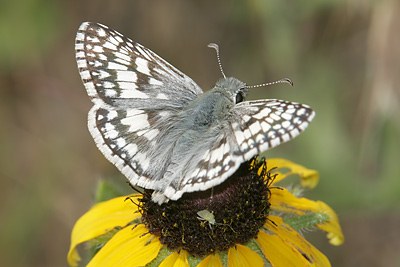
Common Checkered-Skipper
- Habitat
- Open sunny places with low vegetation and bare soil: prairies, meadows, fields, roadsides, landfills, yards, gardens, pastures
- Size
- 1–1 1/2 in (2.5–3.8 cm)
- Lifespan
- Frequently reared adults are known to live about one to two weeks under natural conditions.
- Diet
- Caterpillar: mallow family — globemallows, mallow, hollyhock, alkali mallows, velvet-leaf, poppy mallow. Adult: white composites (shepherd's needle, fleabane, asters), red clover, knapweed, beggar's ticks
About the Common Checkered-Skipper
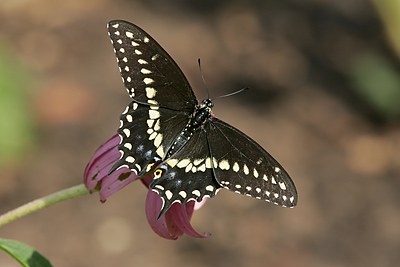
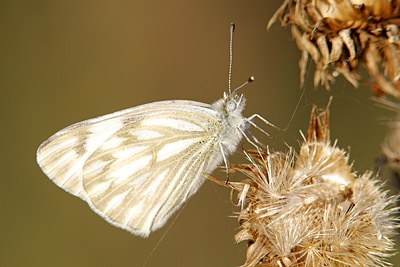
The Common Checkered-Skipper shows one of the more noticeable examples of sexual dimorphism among the region's skippers. Males have an overall blue-gray cast to the wings, produced by long hair-like scales scattered among the checkered black-and-white pattern, while females lack these scales and appear predominantly black with the same checkered white markings, giving the two sexes a distinctly different look in flight even though the underlying wing pattern is shared. Both sexes measure roughly 1 to 1 1/2 inches across the wings. The checkered pattern that gives the species its name consists of small white spots and patches breaking up the darker ground color of both wings, a pattern echoed, with variation, by several related checkered-skippers, so care is needed to confirm identification.
This is a butterfly of open, sunny ground with sparse or low vegetation and patches of bare soil, a description that fits an unusually wide range of settings: prairies, meadows, fields, roadsides, landfills, yards, gardens, and pastures all qualify. Because it favors disturbed and cultivated ground as readily as natural openings, it is one of the more frequently encountered skippers in developed areas, including everyday yards and gardens where its low-growing mallow host plants are tolerated as volunteers.
Caterpillars feed exclusively on plants in the mallow family, including globemallows, common mallow, hollyhock, alkali mallows, velvet-leaf, and poppy mallow, a group of plants that itself thrives in the same open, disturbed ground the adults prefer. Adults nectar at a broad range of flowers, with a particular fondness for white-flowered composites such as shepherd's needle, fleabane, and asters, along with red clover, knapweed, and beggar's ticks, a nectar list weighted toward small, clustered blooms that are easy for a small skipper to work efficiently.
Males seek mates by patrolling low, wet swales and depressions during the afternoon hours, flying back and forth over suitable ground in search of females rather than waiting at a fixed perch, a more active mate-locating strategy than that used by many other skippers. From late afternoon onward, adults of both sexes roost in the open on tall plants rather than tucking into concealed shelter, a habit that leaves them somewhat exposed but also makes them easier for observers to find at day's end. This species is also one of the better-studied skippers, thanks to frequent rearing in captivity, and adults reared and observed under natural conditions are known to live about one to two weeks.
Frequently asked questions
How do male and female Common Checkered-Skippers differ in appearance?
Males appear blue-gray due to specialized hair-like scales, while females lack these scales and look mostly black, both marked with the same checkered white pattern.
Where does this species live?
Almost anywhere with open sun and low vegetation or bare soil — prairies, meadows, fields, roadsides, landfills, yards, gardens, and pastures.
What do the caterpillars eat?
Plants in the mallow family, including globemallows, mallow, hollyhock, alkali mallows, velvet-leaf, and poppy mallow.
How do males locate females?
Males patrol low, wet swales in the afternoon searching for mates, rather than waiting at a fixed perch.
Where to find it
This species favors grassland habitat. See real Oklahoma locations on the Habitats map.