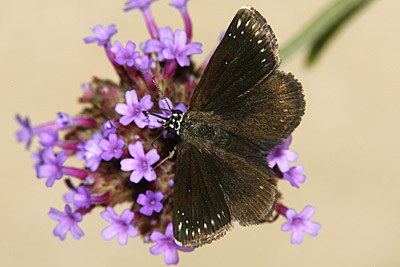
Common Sootywing
- Habitat
- Open/disturbed areas: landfills, vacant lots, gardens, roadsides, fields, pastures
- Size
- 1–1 5/16 in (2.5–3.3 cm)
- Lifespan
- Precise data is unavailable; this small skipper likely lives only one to two weeks as an adult.
- Diet
- Caterpillar: lambsquarters, amaranths, cockscomb. Adult: dogbane, marjoram, oxalis, white clover, common milkweed, peppermint, cucumber, melon
About the Common Sootywing
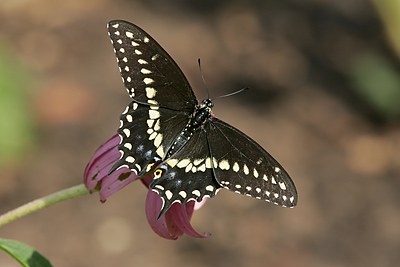
The Common Sootywing is a small, dark skipper, spanning roughly 1 to 1 5/16 inches across the wings. As its name suggests, the upperside is a glossy, almost sooty black, a deeper and shinier black than the dull brown-black typical of many other small skippers, giving fresh individuals a distinctly clean, polished look in good light. This dark ground color is broken only by small white spots scattered across the forewing, and the species shows a modest degree of sexual dimorphism in this pattern: females typically carry more white spots than males, giving them a slightly more marked appearance, though both sexes remain predominantly black overall. The body is likewise dark, and the wings are held broad and rounded, without the narrow, pointed forewing seen in some related duskywings.
The Common Sootywing is a butterfly of open, disturbed ground, turning up in landfills, vacant lots, gardens, roadsides, fields, and pastures. As with several other weedy-ground specialists in its family, it thrives specifically because its host plants are common agricultural and urban weeds, meaning the species often does better in altered, human-influenced landscapes than in untouched natural habitat, and it is a butterfly gardeners and casual observers are reasonably likely to encounter close to home.
Caterpillars feed on lambsquarters, amaranths, and cockscomb, all common weedy plants of cultivated and disturbed ground, consistent with the species' preference for altered habitat. Adults nectar at a wide variety of flowers, including dogbane, marjoram, oxalis, white clover, common milkweed, peppermint, cucumber, and melon, a list that spans both wild plants and cultivated garden and crop plants, underscoring how readily this species exploits human-altered landscapes for both larval hosts and adult nectar sources.
Adults bask with their wings held fully spread flat rather than folded, exposing the dark upperside directly to the sun, a straightforward and effective way for a small-bodied insect to absorb solar heat and raise flight-muscle temperature before becoming active. The species produces two broods each year, an intermediate strategy between the single spring flight of some woodland duskywings and the extended, near-continuous brooding seen in some warm-climate skippers, likely reflecting a temperate flight season long enough to fit in a second generation but not an unbroken succession of broods. Precise lifespan data is unavailable, but this small skipper likely lives only about one to two weeks as an adult, a short individual lifespan typical of small-bodied skippers generally and one that places a premium on prompt mating and egg-laying soon after emergence.
Frequently asked questions
What makes the Common Sootywing's coloring distinctive?
A glossy black upperside marked with small white forewing spots; females tend to show more white spotting than males.
What habitats does it use?
Open, disturbed areas such as landfills, vacant lots, gardens, roadsides, fields, and pastures.
What do the caterpillars feed on?
Lambsquarters, amaranths, and cockscomb — all common weedy plants.
How many generations does it produce each year?
Two broods a year, and adults typically bask with their wings fully spread.
Where to find it
This species favors grassland habitat. See real Oklahoma locations on the Habitats map.