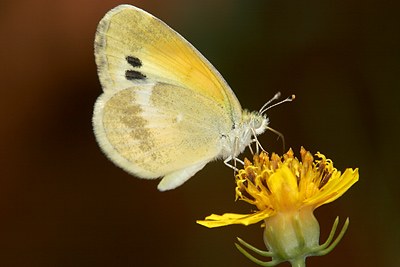
Dainty Sulphur
- Habitat
- Open, dry places: coastal flats, weedy fields, grasslands, road edges, meadows, hillsides
- Size
- ¾–1¼ in (2–3.2 cm)
- Lifespan
- Adult lifespan isn't well documented, but is likely just a couple of weeks like other small sulphurs.
- Diet
- Host: low aster-family plants — shepherd's needle, sneezeweed, fetid marigold, cultivated marigold. Nectar: Labrador tea, asters, wild marigold, rabbitbrush, others
About the Dainty Sulphur
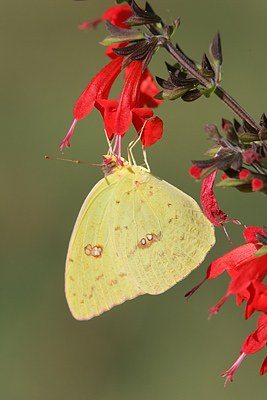
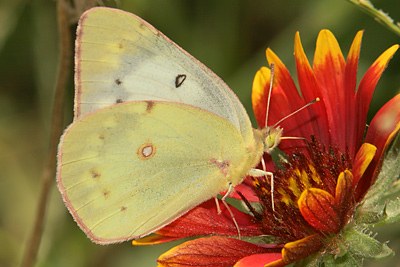
The Dainty Sulphur is the smallest sulphur covered here, and among the smallest in North America, at just ¾ to 1¼ inches across. Its forewing is yellow marked with black patches and borders, while the hindwing often carries a deeper yellow-orange flush, and the underside is finely patterned in a way that helps the butterfly blend into the low, sparse vegetation it favors. Its tiny size alone is often enough to identify it in the field, since almost no other North American sulphur flies quite this small.
This species is found in open, dry places: coastal flats, weedy fields, grasslands, road edges, meadows, and hillsides, generally in sparsely vegetated ground rather than lush habitat. It ranges across much of the southern and western United States and disperses northward in variable numbers each year as the season progresses, occasionally reaching well beyond its normal breeding grounds by late summer before cold weather ends its northern excursion.
Caterpillars feed on low-growing aster-family plants such as shepherd's needle, sneezeweed, fetid marigold, and even cultivated marigold, while adults nectar at a similarly varied list that includes Labrador tea, wild asters, wild marigold, and rabbitbrush. This flexibility in both host and nectar plants likely helps the species persist in the patchy, often marginal habitats it occupies.
Males patrol low over the ground, flying close to the vegetation as they search for females, and mated females lay their eggs singly on seedlings rather than mature plants. One of the Dainty Sulphur's more distinctive behaviors is its basking posture: rather than opening its wings flat to the sun like many butterflies, it rests with wings closed and angled perpendicular to the sun's rays, a position that helps regulate body temperature by controlling how much direct light strikes the wing surface. Adult lifespan is not well documented for this species, but given its small size and the short lives typical of other small sulphurs, individuals likely survive only a couple of weeks, relying on multiple overlapping generations to maintain numbers through the season, a pattern typical of small, fast-developing butterflies that trade individual longevity for sheer reproductive turnover.
Because of its tiny size, the Dainty Sulphur is unusually sensitive to wind and cool temperatures, and on blustery or overcast days it often disappears into low vegetation rather than attempting to fly. Like several other small sulphurs, this species shows a seasonal shift in coloring: individuals that develop during the cooler months of fall and early spring tend to have darker, more heavily marked hindwing undersides than the paler summer generation, a difference thought to help the darker cool-season form absorb solar heat more efficiently during basking. At night and in poor weather, adults roost low, tucked into grass stems or low shrubby cover close to the ground, consistent with the species' generally low, close-to-the-soil flight during the day. Predation pressure on such a small butterfly is intense, and crab spiders ambushing it on flowerheads, along with various small parasitoid wasps attacking the egg and larval stages, likely account for the great majority of individuals that never reach adulthood. Because the Dainty Sulphur breeds continuously through mild-winter regions of the Southwest while only visiting the northern parts of its range briefly each year, the northernmost sightings each season effectively represent the leading edge of a population still expanding outward from source populations much farther south.
Frequently asked questions
How small is the Dainty Sulphur?
It spans only about ¾ to 1¼ inches, making it one of the smallest sulphurs in North America.
Why does it bask with its wings closed at an angle?
Resting with the wings closed and angled perpendicular to the sun helps the butterfly regulate its body temperature.
What plants do the caterpillars feed on?
Low aster-family plants such as shepherd's needle, sneezeweed, and both wild and cultivated marigold.
How do males search for mates?
They patrol low, close to the ground, rather than perching and waiting for females to pass by.
Does the Dainty Sulphur look the same year-round?
No, individuals that develop during cooler months tend to have darker hindwing undersides than summer-generation adults, likely an adaptation for absorbing heat more efficiently.
Where to find it
This species favors grassland habitat. See real Oklahoma locations on the Habitats map.