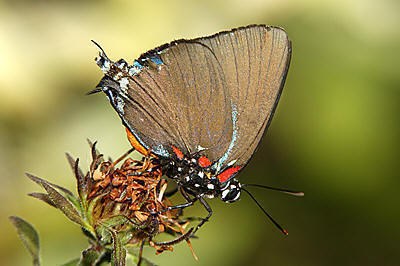
Great Purple Hairstreak
- Habitat
- Oak woods, mesquite forests, planted walnuts (agricultural/suburban), mixed woods with mistletoe
- Size
- 1¼–2 in (3.2–5.1 cm)
- Lifespan
- Adults are short-lived, commonly cited at roughly 1 to 2 weeks.
- Diet
- Host: mistletoe on various trees. Nectar: goldenrod, Hercules club, shepherd's needle, sweet pepperbush, wild plum
About the Great Purple Hairstreak
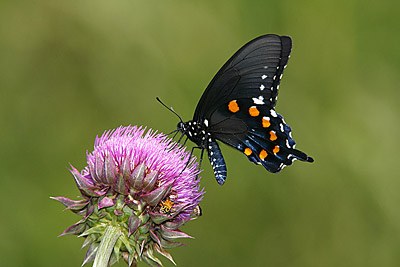
The Great Purple Hairstreak is widely regarded as one of the most beautiful hairstreaks in North America, with an iridescent blue-black upperside that flashes brilliantly in direct sunlight. Its body is tipped with vivid red-orange spots near the base of the wings and along the abdomen, and thin tails extend from each hindwing. The underside is a deep blue-black patterned with additional red-orange spotting near the body, making this a butterfly that rewards a close look far more than most of its relatives. It measures 1¼ to 2 inches across, and its wings often appear almost black until they catch the light at just the right angle, at which point the blue iridescence becomes suddenly obvious.
This species is found wherever its unusual host plant grows: oak woods, mesquite forests, planted walnut groves in agricultural and suburban settings, and mixed woodlands hosting mistletoe. Because mistletoe itself is a parasite that grows on the branches of larger trees, the butterfly's distribution is essentially mapped onto wherever mistletoe infestations occur within its broader range across the southern United States, and a single heavily infested tree can support a small resident colony on its own.
Caterpillars feed exclusively on mistletoe, eating both the leaves and the male flowers of the plant, an unusual and toxic food source that few other insects are able to exploit. Adults nectar at a range of flowers including goldenrod, Hercules club, shepherd's needle, sweet pepperbush, and wild plum, though they spend much of their time high in the tree canopy near their host.
Males take up perches on treetops or other tall vantage points during the afternoon, watching for passing females rather than searching the landscape below. Once mated, the resulting caterpillars complete their development on mistletoe before pupating, and the chrysalis overwinters tucked into crevices in tree bark, camouflaged against predators through the cold months. Adults are relatively short-lived, commonly cited at only about one to two weeks, so the striking coloration of this species is on display for only a brief window each time a new generation emerges, and much of that short adult life is spent well up in the canopy rather than at eye level, which can make the species harder to appreciate than its beauty deserves.
Because its caterpillars feed on a plant that itself contains an assortment of biologically active compounds, some observers have suggested that Great Purple Hairstreak larvae and adults may derive at least mild chemical protection from their mistletoe diet, though this has not been as thoroughly documented as the well-established toxicity of species like the Monarch or Pipevine Swallowtail, so the idea should be treated as plausible rather than confirmed. The species' scientific name places it in the genus Atlides, and it is generally regarded as the largest and showiest hairstreak in North America, distinguished from smaller relatives not only by its size but by the vivid red-orange markings near the body that most other hairstreaks lack entirely. Predators of both the caterpillar and adult stages likely include birds and various ambush predators such as crab spiders, though the caterpillar's habit of feeding on mistletoe growing high in the tree canopy, well above the ground, probably reduces its exposure to some ground-dwelling and lower-canopy predators compared to hairstreaks whose caterpillars feed close to the soil. Because mistletoe itself depends on a healthy population of birds to disperse its sticky seeds from tree to tree, the Great Purple Hairstreak's fortunes are, in a real sense, tied to the same avian seed-dispersal network that first brought its host plant to a given tree.
Frequently asked questions
What do Great Purple Hairstreak caterpillars eat?
They feed exclusively on mistletoe, consuming both its leaves and male flowers.
Why does this butterfly show up near oak and walnut trees?
Its host plant, mistletoe, commonly grows as a parasite on oaks, walnuts, and mesquite, so the butterfly follows wherever mistletoe is established.
Where does the chrysalis spend the winter?
It overwinters tucked into crevices in tree bark, camouflaged from predators.
How do males locate mates?
Males perch high in treetops or on other tall objects during the afternoon and wait for females to fly past.
Is the Great Purple Hairstreak the largest hairstreak in North America?
It is widely regarded as the largest and showiest North American hairstreak, distinguished by size and by vivid red-orange markings that many smaller relatives lack.
Where to find it
This species favors forest habitat. See real Oklahoma locations on the Habitats map.