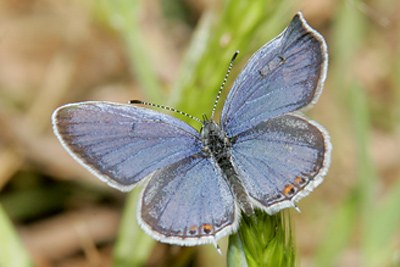
Eastern Tailed-Blue
- Habitat
- Many open, sunny places: weedy areas and disturbed habitats
- Size
- 7/8–1⅛ in (2.2–2.9 cm)
- Lifespan
- Adults typically live roughly one week, consistent with other small lycaenid blues.
- Diet
- Host: pea family — yellow sweet clover, alfalfa, vetch, clover, wild pea, bush clover. Nectar: white sweet clover, shepherd's needle, wild strawberry, winter cress, cinquefoils, asters, others
About the Eastern Tailed-Blue
The Eastern Tailed-Blue is a tiny, common butterfly, ⅞ to 1⅛ inches across, easily recognized by the thin hindwing tail and one or two small orange spots near the tail on the underside, a pattern distinct from the larger eyespot seen in Reakirt's Blue, and the tail itself is thin and easily overlooked unless the butterfly is observed at rest with wings closed. Males show blue uppersides, while females tend toward brownish coloring with blue scaling limited mostly to the wing base.
This species thrives in open, sunny places generally, particularly weedy and disturbed habitats, and is one of the most widespread and frequently encountered small blues across the eastern United States. Its tolerance for disturbed ground means it turns up readily in lawns, roadsides, and vacant lots as well as more natural meadow habitat, and it is often the first small blue a casual observer notices simply because it is everywhere.
Caterpillars feed on pea-family plants including yellow sweet clover, alfalfa, vetch, clover, wild pea, and bush clover, giving them access to host plants in almost any grassy or weedy setting. Adults nectar at white sweet clover, shepherd's needle, wild strawberry, winter cress, cinquefoils, and asters, among other flowers, showing a fairly broad diet as adults even though the caterpillars specialize on legumes.
Males patrol host plants by day searching for females, and the resulting caterpillars feed on the buds, flowers, and seeds of their host rather than the leaves, again favoring the more nutrient-dense reproductive parts of the plant. Unlike several other small blues that overwinter as eggs, the Eastern Tailed-Blue overwinters as a caterpillar, which then pupates the following spring once conditions warm. Adults typically live around one week, consistent with the short lifespans typical of small lycaenid blues generally, but the species compensates with multiple overlapping generations through the growing season, keeping it reliably common from spring through fall across most of its range, so a fresh individual can typically be found on the wing at almost any point during that long window. This near-constant presence is a big part of why the Eastern Tailed-Blue is often the very first small blue that new butterfly watchers learn to recognize.
As with many lycaenid blues, Eastern Tailed-Blue caterpillars are frequently attended by ants, which patrol the caterpillar in exchange for sugary secretions produced from a specialized gland, a mutualism that likely improves larval survival by deterring smaller predators and parasitoid wasps. Adults are also easily confused with the Spring Azure and other small blues where their ranges overlap, though the combination of small size, thin hindwing tail, and the one or two orange spots near that tail reliably separates the Eastern Tailed-Blue from its look-alikes once seen at close range. Across most of its range the species manages three to four overlapping generations per season, and because individual broods blend into one another rather than emerging in sharply defined pulses, fresh adults can be found flying on almost any warm day between the first spring emergence and the final generation in fall. Males detect receptive females partly through pheromones and partly through visual cues, and a female that has already mated typically discourages further mating attempts by fluttering her wings or raising her abdomen when approached by another male, behavior documented across many small blues in this family.
Frequently asked questions
How is the Eastern Tailed-Blue different from Reakirt's Blue?
It shows one or two small orange spots near the hindwing tail rather than the large white-ringed black eyespot seen in Reakirt's Blue.
What do the caterpillars eat?
The buds, flowers, and seeds of pea-family host plants such as clover, alfalfa, and vetch.
How does this species spend the winter?
It overwinters as a caterpillar, which then pupates the following spring.
How long do adults live?
Typically about one week, consistent with other small blues in its family.
Do ants interact with Eastern Tailed-Blue caterpillars?
Yes, ants often tend the caterpillars for the sugary secretions they produce, a mutualism that likely offers the larvae some protection from predators and parasitoids.
Where to find it
This species favors grassland habitat. See real Oklahoma locations on the Habitats map.