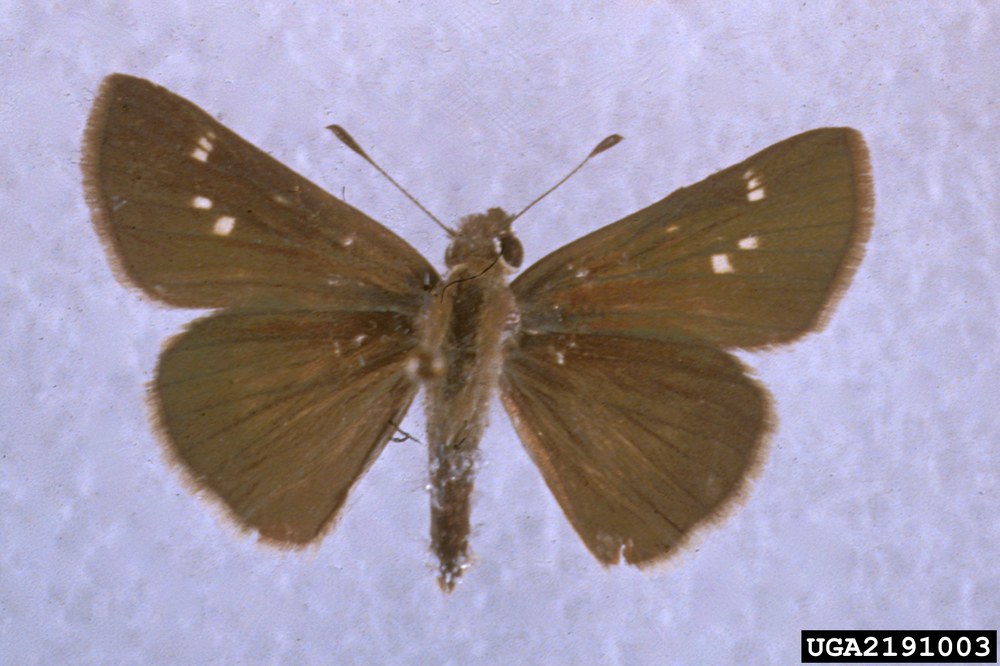
Eufala Skipper
- Habitat
- Open sunny areas: vacant lots, agricultural areas, road edges, lawns
- Size
- 1–1 1/4 in (2.5–3.2 cm)
- Lifespan
- Despite being a wide-ranging colonist in places, its adult lifespan isn't specifically documented; likely a few weeks.
- Diet
- Caterpillar: Johnson grass, Bermuda grass, sugarcane. Adult: croton, alfalfa, composites, lippia, others
About the Eufala Skipper
The Eufala Skipper is a small to medium-sized skipper, measuring roughly 1 to 1 1/4 inches (2.5–3.2 cm) across the wings. Its upperside is a subdued gray-brown, without the bright orange tones seen in many other grass-skippers, and is marked by three to five small, translucent forewing spots that can appear almost glassy when the wings catch the light. Males lack a stigma, the specialized scent-scale patch many male skippers use in courtship, which may mean this species relies more on visual cues or patrolling flight to locate mates rather than pheromone signaling at a perch. The underside of the hindwing is brown, heavily overlaid with gray, and only rarely shows faint spotting, giving the butterfly an overall muted, almost dusty appearance that blends well with dry, open ground. Like other grass-skippers, it rests with its forewings raised at an angle above the flatter hindwings, a posture that likely helps regulate body temperature by controlling how much wing surface is exposed to the sun.
Eufala Skippers favor open, sunny sites with minimal cover, including vacant lots, agricultural fields, road edges, and mowed lawns — largely disturbed or human-altered ground rather than intact natural habitat. This strong association with open, sun-exposed, weedy areas makes it one of the more adaptable skippers, able to colonize new territory readily wherever suitable grasses take hold, including areas well outside its historic range.
Caterpillars feed on common, often weedy grasses — Johnson grass, Bermuda grass, and sugarcane — all of which thrive in the same disturbed, open habitats the adults favor, tying the species' host requirements neatly to its preference for lots, fields, and roadsides. Like other grass-skipper larvae, they likely shelter within a tied or rolled blade of grass while feeding. Adults nectar at a wide variety of flowers, including croton, alfalfa, various composites, and lippia, among others, suggesting a generalist feeding strategy that helps sustain populations even in weedy, marginal habitat with an unpredictable bloom supply.
Despite being a notably wide-ranging colonist that regularly turns up far from its core range, the Eufala Skipper's adult lifespan isn't specifically documented; a life of only a few weeks is likely, in keeping with the short adult stage typical of grass-skippers generally. Its capacity for rapid colonization is likely tied to the widespread availability of its weedy grass hosts and its tolerance of disturbed ground, allowing new populations to establish quickly wherever Johnson grass or Bermuda grass has taken hold, even in areas with no prior record of the species.
Frequently asked questions
What does the Eufala Skipper look like?
Gray-brown above with 3-5 small transparent forewing spots; males lack a stigma.
Where does the Eufala Skipper live?
Open sunny disturbed areas like vacant lots, farmland, road edges, and lawns.
What do Eufala Skipper caterpillars eat?
Johnson grass, Bermuda grass, and sugarcane.
Is the Eufala Skipper a strong colonizer?
Yes, it is known as a wide-ranging colonist that readily establishes in new areas with suitable host grasses.
Where to find it
This species favors grassland habitat. See real Oklahoma locations on the Habitats map.