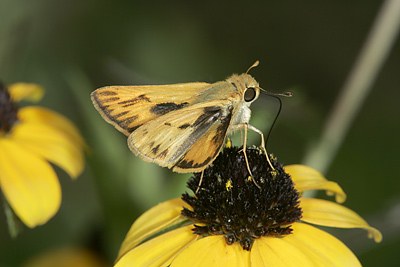
Fiery Skipper
- Habitat
- Sunny open areas: fields, lawns, gardens, levees, roadsides, second-growth scrub
- Size
- 1 1/4–1 1/2 in (3.2–3.8 cm)
- Lifespan
- Field observations suggest adults commonly persist about one to two weeks, sometimes a bit longer.
- Diet
- Caterpillar: Bermuda grass, crabgrass, St. Augustine grass, other grasses. Adult: sweet pepperbush, swamp milkweed, asters, sneezeweed, knapweed, ironweed, thistles
About the Fiery Skipper
The Fiery Skipper shows one of the more pronounced examples of sexual dimorphism among grass skippers: males are yellow-orange with black wing margins, giving them a bright, checkered look, while females are dark brown overall with orange bands crossing the wings, a difference striking enough that the two sexes can look almost like different species to a casual observer. It measures roughly 1 1/4 to 1 1/2 inches (3.2 to 3.8 cm) across the wings, a middling size for the group, and at rest it holds its wings in the angled posture typical of skippers generally. Males rely on a perch-and-wait mating strategy, stationing themselves in lawns and swales and waiting for females to pass rather than actively searching, an energy-efficient approach that works well in open, sunny habitat where a perched male has good visibility and easy basking access to maintain flight-ready body temperature.
This species thrives in sunny open areas: fields, lawns, gardens, levees, roadsides, and second-growth scrub. Its tolerance for heavily mowed and disturbed ground, including residential lawns, makes it one of the more adaptable and commonly encountered skippers, since it does not require the specialized native habitat that many prairie specialists depend on.
Caterpillars feed on a range of grasses, including Bermuda grass, crabgrass, St. Augustine grass, and other turf and lawn species, host plants abundant in exactly the mowed, disturbed settings the adults favor. A documented and distinctive larval behavior is that caterpillars roll and tie grass leaves into shelters within lawn sod, using silk to draw the blades together into a tube-like retreat that offers protection while feeding, a strategy common among Hesperiinae skippers whose larvae specialize on turf and lawn grasses. Adults nectar at a broad list of flowers, including sweet pepperbush, swamp milkweed, asters, sneezeweed, knapweed, ironweed, and thistles, generally landing on the flower head with wings partly spread while the proboscis probes for nectar, a flexible feeding habit that likely supports its wide habitat range.
Field observations suggest adults commonly persist for about one to two weeks, sometimes a bit longer, a lifespan consistent with a species that produces multiple generations across a warm season in disturbed, resource-rich habitat. Between the sheltering behavior of the caterpillars in lawn sod and the perch-based mating strategy of the males, the Fiery Skipper's life cycle appears well adapted to exactly the kind of mowed, human-altered ground where it is most often encountered.
Frequently asked questions
Do male and female Fiery Skippers look different?
Yes, males are yellow-orange with black margins, while females are dark brown with orange bands, a pronounced difference for a skipper.
Where is the Fiery Skipper commonly found?
It thrives in sunny open areas such as fields, lawns, gardens, levees, roadsides, and second-growth scrub.
What is distinctive about Fiery Skipper caterpillar behavior?
Caterpillars roll and tie grass leaves into shelters within lawn sod while feeding on grasses like Bermuda grass, crabgrass, and St. Augustine grass.
How do male Fiery Skippers find mates?
Males perch in lawns and swales and wait for females to pass by, rather than actively patrolling for them.
Where to find it
This species favors grassland habitat. See real Oklahoma locations on the Habitats map.