Funereal Duskywing
- Habitat
- Deserts, warm/arid lowlands, roadsides
- Size
- 1 5/16–1 3/4 in (3.4–4.5 cm)
- Lifespan
- No specific lifespan figures are published; assume the family norm of roughly one to three weeks.
- Diet
- Caterpillar: legumes — New Mexican locust, bur clover, deerweed, desert ironwood, vetch
About the Funereal Duskywing
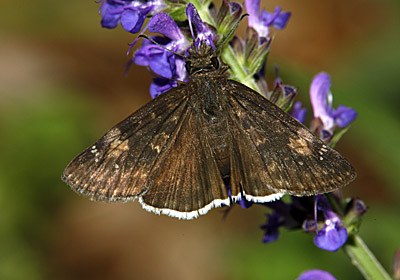
The Funereal Duskywing is a mid-sized to fairly large duskywing, spanning roughly 1 5/16 to 1 3/4 inches across the wings. Its forewing is distinctly narrow and drawn to a point at the tip, a shape more elongated than the broader, more rounded forewing typical of many other duskywings. The upperside is blackish overall, broken only by a dull brown patch in the forewing cell, a subdued marking rather than a bold contrasting spot. The most striking field mark, however, is on the hindwing: a crisp white fringe traces its outer margin, standing out sharply against the dark wing and giving the species its common name, since the somber black-and-white combination has been likened to mourning dress. As in other duskywings, the wings are held flat at rest rather than closed vertically, and the hooked antennal clubs typical of skippers aid in balance during its low, darting flight.
This is a butterfly of hot, dry country: deserts, warm arid lowlands, and the roadsides that cut through them are its typical haunts. It is well adapted to conditions that would be marginal for many other skippers, tolerating high daytime temperatures and sparse vegetation, and it is often among the more conspicuous skippers found basking or nectaring along desert roadways where its legume host plants and flowering shrubs persist despite the aridity.
Caterpillars feed on a range of legumes suited to arid habitats, including New Mexican locust, bur clover, deerweed, desert ironwood, and various vetches, reflecting the same drought-tolerant plant community that defines the species' desert range. Females lay their eggs singly rather than in clusters, placing each egg on the underside of a host leaf, a placement that likely offers the egg some shelter from direct sun and predators in an otherwise exposed, sparsely vegetated environment.
Unlike species restricted to a single spring flight, the Funereal Duskywing produces three broods across an unusually long flight season, from March all the way through December. Such an extended, multivoltine flight pattern is characteristic of warm-climate and desert-dwelling skippers, where mild winters and a long growing season for host legumes allow successive generations to be packed into most of the year rather than compressing reproduction into a brief spring window. No specific lifespan figures have been published for the adult stage, but the family norm of roughly one to three weeks probably applies here as well, meaning each of the three broods represents a fairly quick turnover of short-lived adults rather than one long-lived population persisting throughout the season.
Frequently asked questions
How can you recognize a Funereal Duskywing?
Look for a narrow, pointed forewing with a dull brown cell patch, an overall black upperside, and a crisp white fringe along the hindwing edge.
What kind of habitat does it prefer?
Deserts, warm arid lowlands, and roadsides through such terrain.
How many broods does it produce, and when?
Three broods, with adults flying from March through December, an unusually long season for a skipper.
What do the caterpillars feed on?
Legumes such as New Mexican locust, bur clover, deerweed, desert ironwood, and vetch.
Where to find it
This species favors grassland habitat. See real Oklahoma locations on the Habitats map.