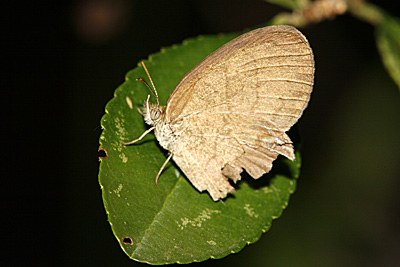
Gemmed Satyr
- Habitat
- Open, wet woodland; grassy zones near water; areas adjacent to streams/ponds
- Size
- 1⅜–1 11/16 in (3.5–4.3 cm)
- Lifespan
- Adult lifespan isn't well documented; probably short, roughly one to two weeks.
- Diet
- Caterpillar: probably Bermuda grass. Adult: "not reported"
About the Gemmed Satyr
The Gemmed Satyr is a small, unassuming butterfly, only 1⅝ to 1 11/16 inches across, wearing plain grayish-brown wings marked with small, subdued eyespots. It lacks the bold patterning of many showier butterflies, and its quiet coloring is easy to overlook in the grassy, semi-shaded habitats it favors, but a closer look rewards the observer with the delicate detail in its wing markings that gives the species its name.
This satyr is a habitat specialist of open, wet woodland and grassy zones near water, turning up in the moist margins around streams and ponds where sunlight filters through a partial canopy. It tends to stay low, flying close to the grass rather than up into the trees, and it shares this damp, semi-open habitat niche with several other small satyrs found across the southeastern and south-central United States.
Unlike many satyr species in which males simply perch and wait, male Gemmed Satyrs actively search out females, patrolling their grassy habitat in pursuit of mates rather than staying put. The caterpillars, which probably feed on Bermuda grass, are nocturnal feeders: they emerge to eat under cover of darkness and retreat to shelter at the base of grass clumps during the day, a pattern that likely reduces their exposure to day-active predators and parasitoids. It is the fourth-instar, or near-final, caterpillars that carry the species through winter in dormancy.
Much about the Gemmed Satyr's adult life remains genuinely undocumented; what adults feed on has simply not been reported in the literature, an unusual gap for a North American butterfly and a reminder that even well-known groups still hold open questions. Based on the short adult lifespans typical of related grass-feeding satyrs, this species probably lives only about one to two weeks as an adult. Its dependence on damp, grassy microhabitats near water makes it a useful signal of healthy wetland-adjacent woodland edges wherever it is found.
The "gemmed" in its name refers to a scattering of small, pale, silvery-white spots along the underside of the hindwing, which catch the light like tiny gems when the butterfly suns itself with wings closed. The species ranges through the southeastern and south-central United States, generally staying low over damp grass, and because so little has been documented about its adult feeding habits, careful field observations of nectaring or puddling behavior remain genuinely valuable to researchers.
The Gemmed Satyr is easily confused with the very similar Carolina Satyr where their ranges meet, and the two are most reliably separated by subtle differences in the shape and arrangement of the small eyespots and pale markings on the hindwing underside, a distinction fine enough that many field guides recommend caution before assigning a sighting to one species over the other. Because both species share the same drab coloring, muted flight, and grassy, shaded habitat preference, some populations are still being sorted out taxonomically, and genetic work in recent decades has helped clarify boundaries between this species and its close relatives in the genus Hermeuptychia. Across the milder parts of its southeastern range, the Gemmed Satyr likely flies in several overlapping generations from spring through fall rather than in sharply separated broods, consistent with the pattern seen in many small, grass-feeding satyrs from warm climates. Its weak, low, bouncing flight close to the grass makes it an easy target for ambush predators such as crab spiders and robber flies, and this vulnerability may be part of why the species relies so heavily on cryptic coloring and a nocturnal caterpillar feeding schedule rather than on speed or agility to avoid being eaten.
Frequently asked questions
How can I recognize a Gemmed Satyr?
It's a small, plain grayish-brown satyr, about 1⅝ to 1 11/16 inches across, with subdued eyespots and none of the bold color of showier butterflies.
What does the Gemmed Satyr caterpillar eat?
Probably Bermuda grass, though its diet isn't fully documented.
When are Gemmed Satyr caterpillars active?
They feed at night and shelter at the base of grass clumps during the day.
How does the Gemmed Satyr find a mate?
Unlike many satyrs that perch and wait, male Gemmed Satyrs actively search out females.
Is the Gemmed Satyr easily confused with other satyrs?
Yes, it closely resembles the Carolina Satyr, and the two are best separated by subtle differences in the eyespots and markings on the hindwing underside.
Where to find it
This species favors wetland habitat. See real Oklahoma locations on the Habitats map.