Goatweed Leafwing
- Habitat
- Deciduous woods and scrub, especially along waterways; open fields, roadsides, railroad tracks
- Size
- 2⅜–3¼ in (6–8.2 cm)
- Lifespan
- Overwinters as an adult and can persist for several months, unusually long-lived for a butterfly.
- Diet
- Caterpillar: goatweed, Texas croton, prairie tea. Adult: sap, rotting fruit, dung, bird droppings
About the Goatweed Leafwing
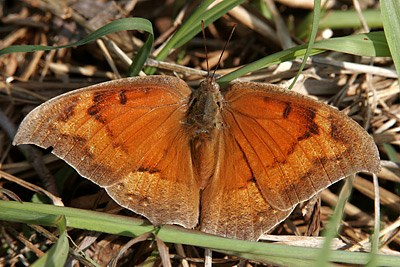
The Goatweed Leafwing is a master of disguise. Spanning 2⅝ to 3¼ inches, its closed wings are mottled gray-brown with fine, leaf-vein-like lines, and each forewing tapers to a small hook that, together with the somber coloring, makes a resting butterfly nearly indistinguishable from a curled dead leaf on the forest floor. Open the wings, however, and the illusion vanishes: males show a bright, burnt-orange upperside crossed with darker bands, while females are duller and more olive-brown, a clear case of sexual dimorphism within this leafwing genus. The contrast between the cryptic underside and the vivid upperside is part of what makes this species so satisfying to spot and identify.
This butterfly favors deciduous woods and scrub, particularly where trees crowd a creek or river bottom, but it is just as comfortable along open fields, roadsides, and old railroad rights-of-way. That tolerance for disturbed, edge habitat reflects the distribution of its host plants, which likewise thrive in sunny, weedy ground rather than deep forest interior. Adults are swift, erratic fliers, difficult to follow in the air, and males stake out clearings or ridgetop openings where they perch and wait, darting out to investigate any passing butterfly in hopes it is a receptive female.
Caterpillars feed exclusively on goatweed, Texas croton, and prairie tea, low weedy plants in the spurge family. Rather than staying in one place, the caterpillar builds a shelter by folding or tying leaves together with silk and relocates to a new shelter as it grows and as its current leaf is consumed, a behavior that helps it avoid predators keyed in on a fixed feeding site. Adults, notably, almost never visit flowers; instead they feed on tree sap, rotting fruit, dung, and even bird droppings, extracting minerals and sugars from these unglamorous sources with a long, efficient proboscis.
What truly sets the Goatweed Leafwing apart is its adult lifespan. Rather than dying off before winter, adults enter a dormant state and overwinter tucked into leaf litter or bark crevices, emerging on warm days and resuming activity the following spring to mate and lay eggs. This lets individual adults persist for several months, unusually long-lived for a butterfly, most of which measure their adult lives in days or weeks rather than seasons.
Male Goatweed Leafwings are strongly territorial, defending a favored perch, often a sunlit spot on a tree trunk, low branch, or patch of bare ground, from which they dart out to investigate any passing insect and quickly return once the intruder is chased off or identified as uninteresting. This perching strategy is common among leafwings and their close relatives, and it allows a male to conserve energy while still maintaining a reliable vantage point for spotting receptive females. Where its range overlaps with the very similar Tropical Leafwing farther south, the two species can be difficult to separate in the field, and confirming an identification sometimes requires a close look at subtle differences in wing shape and the exact pattern of the underside markings. During its unusually long overwintering period as an adult, the Goatweed Leafwing relies heavily on its leaf-like camouflage, tucking into leaf litter, brush piles, or bark crevices where its mottled, hooked-wing silhouette is nearly impossible to distinguish from the dead foliage around it, emerging to bask and feed only on unseasonably warm winter days before returning to shelter as temperatures drop again.
Frequently asked questions
How can I tell a Goatweed Leafwing from other butterflies?
Look for the hooked wingtips and mottled, leaf-like underside that camouflages the resting butterfly, paired with a bright orange upperside (duller in females) revealed only in flight.
What do Goatweed Leafwing caterpillars eat?
They feed on goatweed, Texas croton, and prairie tea, building and relocating leaf shelters as they grow.
Do adult Goatweed Leafwings visit flowers for nectar?
Rarely, if ever. They prefer sap, rotting fruit, dung, and even bird droppings over flower nectar.
How long do Goatweed Leafwing adults live?
They overwinter as adults and can survive for several months, unusually long-lived for a butterfly.
How does the Goatweed Leafwing survive as an adult through winter?
It shelters in leaf litter or bark crevices, relying on its leaf-like camouflage, and emerges to bask or feed only on unseasonably warm winter days.
Where to find it
This species favors forest habitat. See real Oklahoma locations on the Habitats map.