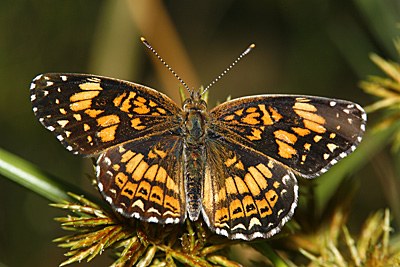
Gorgone Checkerspot
- Habitat
- Open ridges, prairies, stream borders, open hardwood forests, abandoned fields, forest margins
- Size
- 1¼–1¾ in (3.2–4.5 cm)
- Lifespan
- Adults probably live about two weeks; precise longevity data for this species is sparse.
- Diet
- Caterpillar: sunflower family — sunflower, crosswort. Adult: nectar, especially yellow flowers
About the Gorgone Checkerspot
The Gorgone Checkerspot is a small to medium checkerspot, 1¼ to 1¾ inches across, with an orange-brown upperside crossed by a bold black checkered pattern typical of its genus. The underside of the hindwing is paler, often cream or white, outlined with brown in a checkered pattern accented by small dark spots, a combination that helps distinguish it from other checkerspots sharing its habitat, since the checkering below is generally crisper and paler than the more uniformly dark undersides of some related species.
This species is found on open ridges, prairies, stream borders, open hardwood forests, abandoned fields, and forest margins, giving it a broader habitat tolerance than some more specialized checkerspots, and it ranges across a substantial swath of the central and eastern United States, generally favoring drier, more open ground than many of the woodland-edge fritillaries and hairstreaks it can sometimes be found alongside.
Caterpillars feed on sunflower-family plants, specifically sunflower and crosswort, while adults nectar widely but show a particular preference for yellow flowers, a pattern noted consistently in observations of this species' feeding behavior.
Because brood number in the Gorgone Checkerspot varies by latitude, populations in the north typically manage only a single generation per year, while those farther south can complete two or even three generations within the same warm season, a flexibility that lets the species make efficient use of longer growing seasons where they are available. Precise data on adult longevity is sparse for this species, but adults probably live around two weeks, in keeping with typical lifespans for checkerspots generally. Much of what is documented about the Gorgone Checkerspot's biology centers on this latitude-dependent brood structure, since detailed behavioral observations, such as specific mate-locating strategies or precise overwintering stage, remain less thoroughly studied compared to some of the more intensively researched fritillaries and hairstreaks covered elsewhere in this reference, which makes careful field observations from local naturalists especially valuable for filling in the remaining gaps. Even basic questions, such as exactly how the species spends the winter in the northern part of its range, remain less firmly settled than the equivalent details for many better-studied fritillaries and hairstreaks.
The Gorgone Checkerspot can be confused with several similarly patterned species sharing its range, particularly the Silvery Checkerspot and various Phyciodes crescents, and careful attention to the crisper, paler checkering on the hindwing underside, along with the specific arrangement of dark spots, usually helps confirm an identification. As in many checkerspots, males likely patrol open habitat searching for females rather than relying solely on perching, though detailed courtship behavior has not been closely studied in this particular species. Predation pressure on the caterpillars probably comes mainly from birds and from parasitoid wasps and flies that target checkerspot larvae generally, a pressure severe enough in many Chlosyne species that only a small fraction of eggs laid ever survive to become flying adults. Because sunflower and crosswort, the species' known host plants, are themselves widespread across dry prairies, roadsides, and disturbed ground, the Gorgone Checkerspot's distribution likely tracks the availability of open, sun-exposed habitat more than any single narrow microhabitat requirement, helping explain why it turns up across such a broad swath of the central and eastern United States despite the relatively sparse documentation of its finer-grained natural history. Records submitted through citizen-science observation platforms have become an increasingly valuable source of new information on this species precisely because formal, targeted field research on its behavior remains comparatively scarce.
Frequently asked questions
How many generations does the Gorgone Checkerspot produce each year?
It varies by latitude, from a single generation in the north to two or three generations per season farther south.
What do the caterpillars eat?
Sunflower-family plants, specifically sunflower and crosswort.
Do adults prefer any particular flower color?
They show a noted preference for yellow flowers when nectaring, though they visit a range of blooms.
How long do adult Gorgone Checkerspots live?
Precise data is limited, but they probably live around two weeks, similar to other checkerspots.
What other species can be confused with the Gorgone Checkerspot?
It can resemble the Silvery Checkerspot and various Phyciodes crescents, and is best confirmed by the crisper, paler checkering pattern on the hindwing underside.
Where to find it
This species favors grassland habitat. See real Oklahoma locations on the Habitats map.