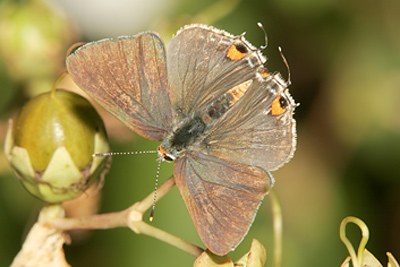
Gray Hairstreak
- Habitat
- Open, nonforested sites; common in disturbed, weedy areas
- Size
- 7/8–1⅜ in (2.2–3.5 cm)
- Lifespan
- Adults commonly live several weeks, with some individuals surviving close to a month.
- Diet
- Host: beans, clovers, cotton, mallow; young caterpillars eat flowers/fruits, older ones leaves. Nectar: dogbane, milkweed, mint, winter cress, goldenrod, tick trefoil, white sweet clover
About the Gray Hairstreak
The Gray Hairstreak is the most widely distributed hairstreak in North America, and its overall gray coloring on both wing surfaces makes it somewhat plainer than showier relatives like the Great Purple or Juniper Hairstreak. Still, it carries the classic hairstreak field marks: a postmedian line of black and white edged in orange near the hindwing's blue-capped tail, along with a small red-orange spot nearby. It ranges from ⅞ to 1⅛ inches across, and the hindwing tail itself likely functions as a false antenna, drawing a predator's strike toward the wing margin rather than the vulnerable head and body.
True to its wide distribution, this species turns up in open, nonforested sites almost everywhere, and it is especially common in disturbed, weedy habitats such as vacant lots, roadsides, and field edges. Its adaptability to human-altered landscapes is a major reason it can be found across nearly the entire continental United States and well into Mexico, making it one of the few hairstreaks a beginning butterfly-watcher is likely to encounter in a typical backyard or park.
What truly sets the Gray Hairstreak apart is its extraordinarily broad host plant range, among the widest of any North American butterfly: caterpillars feed on beans, clovers, cotton, and mallow, among many other plants, rather than specializing on one plant family the way most hairstreaks do. Young caterpillars start out eating flowers and developing fruits, then shift to eating leaves as they mature. Adults nectar widely too, visiting dogbane, milkweed, mint, winter cress, goldenrod, tick trefoil, and white sweet clover.
Males perch on small trees or shrubs during the afternoon, watching for females rather than patrolling continuously. Females lay their eggs singly on flowers of the host plant, matching the caterpillars' early preference for flower and fruit tissue. The chrysalis overwinters, and because this species produces multiple generations across a long flight season, adults are seen from spring well into fall in much of its range. Individual adults commonly live several weeks, with some surviving close to a month, longer than many of the small blues and other hairstreaks covered here, a longevity advantage that may partly explain why this species is so consistently seen across such a long flight season.
The Gray Hairstreak's false-head illusion is one of the more elegant defensive adaptations among small butterflies: at rest, it often rubs its hindwings together in a slow, back-and-forth motion that moves the blue-capped tails and nearby eyespot as if they were antennae and a head, drawing a predator's attention and strike toward this decoy rather than the real head tucked at the opposite end of the closed wings. Because its caterpillars will feed on beans and cotton among their huge range of host plants, the species is occasionally noted as a very minor agricultural pest in some regions, though its impact is generally far smaller than that of dedicated crop pests, and most gardeners simply tolerate the caterpillars given the adult butterfly's harmlessness and appeal. Males locate mates by perching on shrubs during the warmest part of the afternoon and darting out to investigate passing insects, a strategy that requires less energy expenditure than continuous patrolling and that suits a species active across such a long flight season. Predators of the Gray Hairstreak include birds, robber flies, and crab spiders, though the false-head decoy likely reduces the proportion of strikes that land on a vital part of the body, letting a wounded but living butterfly fly on with only a torn hindwing tail to show for the encounter.
Frequently asked questions
What makes the Gray Hairstreak unusual among hairstreaks?
It has an exceptionally broad host plant range, feeding on beans, clovers, cotton, mallow, and many other unrelated plants rather than specializing.
Do the caterpillars always eat the same plant parts?
No, young caterpillars eat flowers and fruits first, then shift to eating leaves as they grow older.
How long do adult Gray Hairstreaks live?
Commonly several weeks, with some individuals living close to a month.
Where does this butterfly spend the winter?
It overwinters as a chrysalis.
How does the Gray Hairstreak fool predators?
It rubs its hindwings together to move the tails and nearby eyespot like a false antenna and head, drawing a predator's strike away from its actual head.
Where to find it
This species favors grassland habitat. See real Oklahoma locations on the Habitats map.