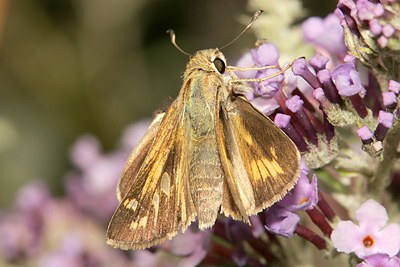
Green Skipper
- Habitat
- Mesquite grassland, chaparral, prairie, canyons, ravines, roadsides, dunes
- Size
- 1–1 1/2 in (2.5–3.8 cm)
- Lifespan
- Lifespan isn't specifically documented; likely similar to related Hesperia species at a few weeks.
- Diet
- Caterpillar: blue grama, fluff grass, buffalograss
About the Green Skipper
The Green Skipper displays a bright golden-orange upperside, but its most distinctive feature is on the hindwing below: a bright green-orange to yellow-orange ground color crossed by a band of white spots, a combination of hue and pattern that helps separate it from other orange grass skippers sharing its arid and semi-arid range. It measures roughly 1 to 1 1/2 inches (2.5 to 3.8 cm) across the wings, a middling size within the group, and like other skippers it rests with its forewings angled above its flatter hindwings, a posture that may help it warm quickly in the sun given the exposed, often sparsely vegetated terrain it favors. The greenish cast on the hindwing underside is somewhat unusual among grass skippers, most of which run toward straightforward orange, brown, or gray tones, making this a genuinely useful field mark where the species occurs.
This skipper occupies a wide range of dry, open habitats: mesquite grassland, chaparral, prairie, canyons, ravines, roadsides, and dunes. That breadth suggests real tolerance for varied and often harsh terrain, from rocky canyon country to loose dune sand, unified mainly by open exposure to sun and the presence of its specific host grasses rather than any single vegetation type. Such wide habitat tolerance is fairly typical of skippers whose caterpillars specialize on drought-hardy grasses, since those grasses themselves tend to persist across a broad span of dry landscape types rather than being tied to one particular soil or elevation.
Caterpillars feed on blue grama, fluff grass, and buffalograss, all short, drought-tolerant grasses characteristic of arid and semi-arid grassland, well matched to the dry habitats the species occupies. As with related Hesperia skippers, larvae likely shelter at the base of host grass clumps or in silk-lined tubes during the day, emerging to feed and offering some protection from both predators and the intense sun typical of open, dry terrain.
Males employ a perch-based mating strategy, stationing themselves in gulches and waiting for females to pass through rather than patrolling widely, a behavior likely favored by the funneling effect of narrow drainages and ravines that concentrate butterfly movement through predictable corridors in otherwise open, exposed terrain. Lifespan isn't specifically documented for the Green Skipper, but it is likely similar to related Hesperia species, on the order of a few weeks as an adult, a pattern consistent with a species whose caterpillars, rather than adults, carry the bulk of the year-to-year population through on tough, resilient native grasses.
The Green Skipper can be confused with other similarly sized Hesperia skippers sharing its arid range, particularly the Uncas Skipper, and separating the two often comes down to the precise shade and pattern of the hindwing underside spot band, a distinction that can be subtle enough to require a clear, close photograph rather than a fleeting field view. As with many grass skippers, courtship likely involves close visual and chemical cues once a female enters a male's gulch territory, though detailed behavioral studies specific to this species remain limited. Predators of the caterpillars probably include birds, ants, and various parasitoid wasps that specialize on grass-feeding skipper larvae, while adults face the usual gauntlet of ambush predators lying in wait on the sparse flowers available in its dry habitat. Because its host grasses are widespread and drought-tolerant, the Green Skipper is less tied to any single soil type or elevation than many range-restricted butterflies, and its populations likely fluctuate significantly from year to year in step with rainfall, since a dry season that stunts blue grama and buffalograss growth would be expected to reduce host plant quality and, in turn, caterpillar survival the following generation.
Frequently asked questions
What does the Green Skipper look like?
It has a bright golden-orange upperside, while the hindwing underside is bright green-orange to yellow-orange with a band of white spots.
What habitats does the Green Skipper occupy?
It occupies mesquite grassland, chaparral, prairie, canyons, ravines, roadsides, and dunes.
What grasses do Green Skipper caterpillars eat?
Caterpillars feed on blue grama, fluff grass, and buffalograss.
Where do male Green Skippers wait for mates?
Males perch in gulches, waiting for females to pass through, rather than patrolling widely.
What other skipper is easily confused with the Green Skipper?
The Uncas Skipper is a similar species sharing its arid range, and the two are often separated only by close attention to the hindwing underside pattern.
Where to find it
This species favors grassland habitat. See real Oklahoma locations on the Habitats map.