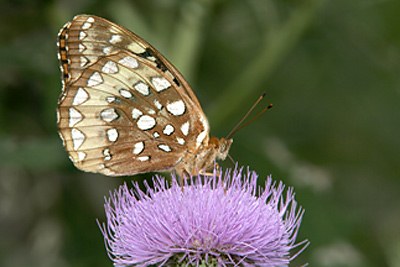
Great Spangled Fritillary
- Habitat
- Open, moist fields, valleys, pastures, meadows, open woodland, prairies
- Size
- 2½–4 in (6.3–10.1 cm)
- Lifespan
- Individual adults typically live around 2 to 3 weeks despite a long summer flight season.
- Diet
- Caterpillar: various violets. Adult: milkweeds, thistles, ironweed, dogbane, mountain laurel, verbena, vetch, bergamot, red clover, joe-pye weed, purple coneflower
About the Great Spangled Fritillary
The Great Spangled Fritillary is one of the largest fritillaries in North America, spanning 2½ to 4 inches, with an orange-brown upperside marked by black spots and lines. Its underside is the real showpiece: the hindwing carries a row of large, brilliant silver spots set against a rich brown or olive background, the feature that gives this whole group of butterflies the name "spangled" fritillary, and the spots are visible even from a distance, making the species easy to confirm once it settles onto a flower with wings folded.
Like the Variegated Fritillary, this species favors open, moist fields, valleys, pastures, meadows, open woodland, and prairies, though as a true Speyeria fritillary it tends to be more tightly associated with quality meadow habitat rather than colonizing disturbed ground as readily as its more generalist relative, the Variegated Fritillary.
Caterpillars feed exclusively on violets, while adults nectar at a wide range of flowers, including milkweeds, thistles, ironweed, dogbane, mountain laurel, verbena, vetch, bergamot, red clover, joe-pye weed, and purple coneflower, providing ample fuel across a long summer flight season.
Males search open habitat for females rather than perching in one place, and females lay their eggs near, rather than directly on, violet plants in late summer. The resulting caterpillars hatch quickly but do not feed right away, instead entering a dormant overwintering state as tiny, unfed larvae, one of the more unusual life-history strategies among North American butterflies. The following spring, these caterpillars emerge from dormancy and seek out young violet leaves to begin feeding for the first time. Despite a flight season that can stretch across much of the summer, this reflects staggered emergence among individuals rather than a long-lived adult stage; individual adults typically live only around two to three weeks, with the species producing just a single generation each year, a slower reproductive pace than many of the multi-brooded sulphurs and blues profiled elsewhere in this reference. This single-brood strategy is typical of Speyeria fritillaries generally, which tend to trade rapid reproduction for a long, well-synchronized emergence tied closely to their region's growing season, relying on the resilience of dormant, unfed larvae to carry the species safely through winter rather than on sheer numbers of broods.
The Great Spangled Fritillary can be confused with several closely related Speyeria fritillaries sharing its range, especially the Aphrodite Fritillary, and separating the two typically requires close attention to subtle differences in the width of the dark border and the exact shade of the ground color, since both share the same basic silver-spangled pattern. Males patrol open meadow habitat throughout the day searching for females, relying at least partly on visual cues and pheromones to locate a mate rather than defending a fixed perch. Because this species depends entirely on violets, which themselves generally require some combination of partial shade, leaf litter, and undisturbed soil to thrive, the ongoing loss and fragmentation of quality meadow and open-woodland habitat across much of the East is thought to be gradually reducing the extent of suitable violet-rich ground available to support new generations, a concern shared broadly across the whole genus. The unfed, newly hatched caterpillars that overwinter each year are extremely vulnerable during that dormant period, facing risks from freezing weather, flooding, and small ground-dwelling predators, and this vulnerable overwintering stage may be one of the more significant natural bottlenecks limiting the species' overall abundance from one year to the next.
Frequently asked questions
Where does the name "spangled" fritillary come from?
The underside of the hindwing carries a row of large, brilliant silver spots against a brown or olive background, resembling spangles.
What do the caterpillars eat?
They feed exclusively on violets.
Why do newly hatched caterpillars not feed right away?
They overwinter as tiny, unfed larvae in a dormant state and only begin feeding on fresh violet leaves the following spring.
How many generations does this species produce per year?
Just one, despite a flight season that stretches across much of the summer due to staggered adult emergence.
What other butterfly is most easily confused with the Great Spangled Fritillary?
The Aphrodite Fritillary is very similar, and the two are usually separated by subtle differences in border width and ground color shade.
Where to find it
This species favors grassland habitat. See real Oklahoma locations on the Habitats map.