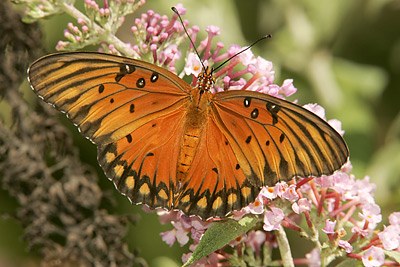
Gulf Fritillary
- Habitat
- Pastures, open fields, second-growth subtropical forest and edges, city gardens
- Size
- 2½–3¾ in (6.3–9.5 cm)
- Lifespan
- Adults generally live about 2 to 4 weeks after emerging.
- Diet
- Host: passion-vines — maypops, running pop. Nectar: lantana, shepherd's needle, cordias, composites, others
About the Gulf Fritillary
The Gulf Fritillary is a large, vividly colored butterfly, 2½ to 3¾ inches across, with a bright orange upperside marked by bold black lines and spots, and elongated wings that give it a distinctive silhouette in flight. Its underside is unlike almost any other North American butterfly: densely covered in elongated, mirror-bright silver spots set against a warm brown background, a pattern so striking it is often what people remember most about the species, and it remains visible even when the butterfly is at rest with its wings folded, unlike the muted upperside pattern.
This species is found in pastures, open fields, second-growth subtropical forest and its edges, and city gardens, with its core range across the Gulf Coast states and much of the Deep South, though it strays and colonizes much farther north during summer months wherever its host vines can be found, including garden-planted passionflower vines well outside its natural breeding range.
Caterpillars feed on passion-vines, particularly maypops and running pop, plants that also serve to protect the caterpillars somewhat, since passionvine tissue contains compounds that make the resulting caterpillars and butterflies distasteful to many predators. Adults nectar widely, visiting lantana, shepherd's needle, cordias, and various composite flowers.
Males patrol open habitat searching for females, who then lay eggs directly on the host plant. Caterpillars are capable of feeding on most parts of the passionvine, including leaves, stems, and tendrils, and their bright orange bodies marked with branching black spines serve as a visual warning to predators, advertising their unpalatability rather than functioning as a physical defense, since the spines themselves are soft and harmless to the touch. Adults generally live two to four weeks, and in the southern part of the range, populations overwinter as adults, allowing the Gulf Fritillary to maintain a presence in mild climates year-round while still expanding northward as a strong colonizer each summer, a combination that makes it one of the more reliably seen large fritillaries across a very wide swath of the country. Gardeners who plant passionvine specifically to attract this species are often rewarded within a single season, since females readily find and lay eggs on newly established vines.
Despite its common name, the Gulf Fritillary is only a distant relative of the true Speyeria fritillaries covered elsewhere in this reference; taxonomically it belongs instead to the longwing group, or Heliconiinae, a mostly tropical lineage centered on passionvine-feeding butterflies and best known for the diverse, brilliantly patterned Heliconius species of Central and South America. Females detect suitable host vines largely through chemical cues on the leaf surface, tasting potential plants with sensory organs on their feet before committing to lay eggs, a behavior widespread among butterflies whose caterpillars can only survive on a narrow set of host plants. Parasitoid wasps and flies that specifically target passionvine-feeding caterpillars can inflict heavy losses on Gulf Fritillary broods in some years, and this pressure, more than predation by birds, likely represents the single biggest natural check on population growth given how effectively the caterpillars' toxicity deters most vertebrate predators. Because the species breeds so quickly and disperses so readily, isolated garden plantings of passionvine can sometimes attract far more egg-laying females than the young vine can support, leading to caterpillars stripping a small plant nearly bare within days, a common and mildly frustrating experience for gardeners who plant passionvine specifically to draw this butterfly.
Frequently asked questions
What makes the underside of the Gulf Fritillary so distinctive?
It is covered in elongated, mirror-bright silver spots set against a brown background, unlike most other North American butterflies.
Are the caterpillar's spines dangerous to touch?
No, the branching black spines look intimidating but are soft, serving as a visual warning rather than a physical defense.
What plants do the caterpillars feed on?
Passion-vines, particularly maypops and running pop, whose chemical compounds also make the caterpillars distasteful to predators.
How does the Gulf Fritillary survive winter?
In the southern part of its range, adults overwinter directly, while the species also recolonizes areas farther north each summer.
Is the Gulf Fritillary a true fritillary?
Not closely; it belongs to the longwing group (Heliconiinae) rather than the Speyeria genus of true fritillaries, making the resemblance more a matter of common naming than close relation.
Where to find it
This species favors grassland habitat. See real Oklahoma locations on the Habitats map.