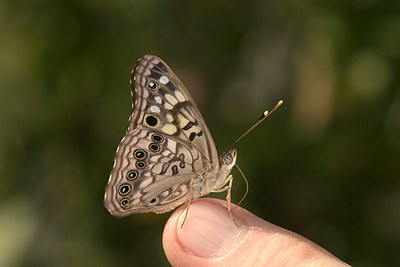
Hackberry Emperor
- Habitat
- Along wooded streams, forest glades, river edges, wooded roadsides, towns
- Size
- 1⅜–2½ in (3.5–6.3 cm)
- Lifespan
- Adults typically live around 2 to 3 weeks.
- Diet
- Caterpillar: hackberries and sugarberry. Adult: sap, rotting fruit, dung, carrion; drinks moisture at wet spots
About the Hackberry Emperor
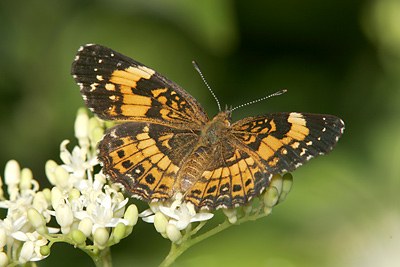
The Hackberry Emperor is a medium-sized butterfly, 1⅜ to 2½ inches across, dressed in mottled brown and tan with a scattering of dark eyespots and a cluster of small white spots near the tip of each forewing. The overall pattern is subtle rather than showy, blending well with tree bark, and the wing shape is slightly angular with a squared-off forewing tip. It is one of the more approachable butterflies to observe up close, since it frequently lands on people, drawn to the salt and moisture in perspiration as a substitute for its usual mineral sources.
True to its name, this species is tied closely to hackberry and sugarberry trees, and it turns up wherever those trees grow: along wooded streams, in forest glades, on river edges, beside wooded roadsides, and even in shaded towns and city parks. Adults have a rapid, erratic, darting flight that makes them hard to track visually, and they habitually rest head-downward on tree trunks, wings flattened against the bark, where their coloring helps them disappear from view.
Females lay their eggs in clusters rather than singly, and the caterpillars that hatch feed communally on hackberry and sugarberry leaves, a social strategy that may offer some safety in numbers during the vulnerable early instars. As cooler weather arrives, groups of young caterpillars roll dead leaves together and overwinter clustered inside, sheltered from freezing temperatures until host trees leaf out again in spring. Adults themselves shun flowers almost entirely, instead feeding on tree sap, rotting fruit, dung, and carrion, and they will gather at damp soil or mud to drink moisture and dissolved minerals, a behavior known as puddling.
Adult Hackberry Emperors are relatively short-lived, typically surviving only about two to three weeks, so the population one sees at a given hackberry grove in early summer is often largely replaced within a month. Multiple generations can occur across the warm season, with each new brood of caterpillars returning to the same hackberry trees that sustained their parents, making a mature hackberry stand a reliable, season-long site for observing this species at every life stage.
The species ranges across most of the eastern and central United States, tracking the distribution of hackberry trees rather closely, and it is generally absent from regions where these trees do not grow. Its habit of puddling at damp soil and landing readily on people and vehicles makes it one of the easier satyr-relatives to observe and photograph up close in the field.
Frequently asked questions
Where are Hackberry Emperors most commonly found?
Along wooded streams, forest glades, river edges, and even in towns, essentially wherever hackberry or sugarberry trees grow.
Why do Hackberry Emperors land on people?
They are attracted to salts and moisture in sweat, one of several substitutes for the sap, dung, and rotting fruit they normally feed on.
What do Hackberry Emperor caterpillars eat, and how do they survive winter?
They feed on hackberry and sugarberry leaves, and young caterpillars overwinter in groups inside rolled dead leaves.
How long do adult Hackberry Emperors live?
Typically around two to three weeks.
Where to find it
This species favors wetland habitat. See real Oklahoma locations on the Habitats map.