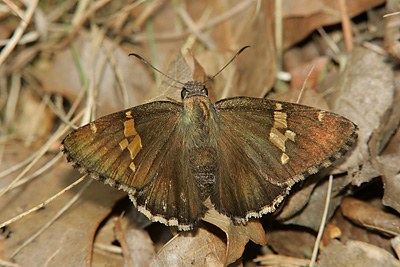
Hoary Edge
- Habitat
- Open woodland/brushy areas, especially oak or pine woods with sandy soil
- Size
- 1 3/4–1 15/16 in (4.5–4.9 cm)
- Lifespan
- Species-specific data is scarce; skippers generally survive only a few weeks as adults.
- Diet
- Caterpillar: Desmodium, occasionally Baptisia, Lespedeza. Adult: common milkweed, dogbane, buttonbush, Japanese honeysuckle, New Jersey tea
About the Hoary Edge
The Hoary Edge is a compact, dark-winged skipper measuring just 1¾ to just under 2 inches across, easily overlooked at first glance but distinctive once you know what to look for. Its upperwings are a deep, almost blackish brown, crossed by a translucent gold or yellow band on the forewing that catches the light in flight. The real giveaway, though, is on the underside of the hindwing: a wide, frosty silvery-white band that gives the species both its common name and its most reliable field mark, standing out sharply against the otherwise dark wing surface.
This skipper favors open woodland and brushy edges, particularly oak or pine woods growing on sandy soil, a habitat type that supports both its host plants and the open sunny patches it needs for basking and perching. Caterpillars feed primarily on Desmodium, commonly known as tick-trefoil, with occasional use of Baptisia and Lespedeza as alternate hosts — all members of the pea family that thrive in the dappled light of woodland openings. Adults nectar at a range of flowers including common milkweed, dogbane, buttonbush, Japanese honeysuckle, and New Jersey tea, taking advantage of whatever is blooming along the woodland edge through the flight season.
Male Hoary Edges display a strongly territorial perching behavior that's a hallmark of the species. A male will stake out a spot roughly 3 to 6 feet up on a branch within a sunlit forest opening and hold it, darting out to intercept passing insects — whether rival males, other butterflies, or potential mates — before returning to the very same perch. This perch fidelity can persist for extended periods, with a male essentially defending a small aerial territory from a fixed vantage point rather than patrolling widely in search of females.
As with many skippers, detailed lifespan data for this species is limited, but adults are believed to follow the typical skipper pattern of surviving only a few weeks in the wild. The combination of habitat specificity — sandy-soil oak and pine woods — and reliance on Desmodium makes the Hoary Edge a useful indicator of healthy, structurally diverse woodland edge habitat.
The Hoary Edge is sometimes confused with the more common Silver-spotted Skipper, which shares a generally similar dark brown coloring and a pale patch on the hindwing underside, but the Silver-spotted Skipper is noticeably larger and shows a bright white, sharply defined patch rather than the softer, frostier silvery-white band that gives the Hoary Edge its name. Caterpillars build a shelter by folding over a section of a host leaf and securing it with silk, retreating there during the day and emerging mainly at night or during cooler, overcast conditions to feed, a pattern that likely reduces their exposure to day-active birds and parasitoid wasps. Like many skippers, adult Hoary Edges bask with their wings held in a distinctive posture, forewings raised above flatter, more horizontal hindwings, a position thought to expose more wing surface to the sun for faster warming than a fully open or fully closed posture would allow. Because the species relies so heavily on sandy-soil oak and pine woodland with well-developed Desmodium populations in the understory, its distribution tends to be patchy even within otherwise suitable-looking forest, tracking the specific combination of open, sunlit understory and legume-rich ground cover more closely than the general forest type alone would predict.
Frequently asked questions
Where does the name 'Hoary Edge' come from?
It refers to the wide, frosty silvery-white ('hoary') band on the underside of the hindwing, the species' most distinctive field mark.
What do Hoary Edge caterpillars eat?
Primarily Desmodium (tick-trefoil), with occasional use of Baptisia and Lespedeza as host plants.
How do male Hoary Edges behave when looking for mates?
Males perch about 3 to 6 feet up on a branch in a sunlit forest opening, chase off intruders, and return repeatedly to that same perch.
What habitat should I look in to find one?
Open woodland or brushy areas, especially oak or pine woods growing on sandy soil.
How is the Hoary Edge different from the similar Silver-spotted Skipper?
The Silver-spotted Skipper is larger with a bright, sharply defined white hindwing patch, while the Hoary Edge shows a softer, frostier silvery-white band.
Where to find it
This species favors forest habitat. See real Oklahoma locations on the Habitats map.