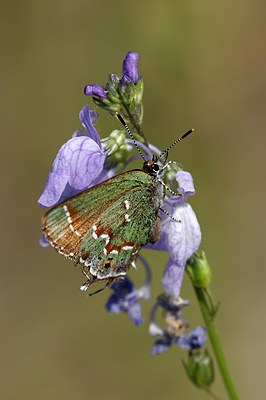
Juniper Hairstreak
- Habitat
- Old fields, bluffs, barrens, juniper/pinyon-juniper woodlands, cedar breaks
- Size
- 1–1¼ in (2.6–3.2 cm)
- Lifespan
- Adults typically live only about a week after emerging.
- Diet
- Host: redcedar, California juniper, Utah juniper. Nectar: winter cress, dogbane, common milkweed, wild carrot, shepherd's needle, butterflyweed, white sweet clover
About the Juniper Hairstreak
The Juniper Hairstreak stands out among North American hairstreaks for its green coloring, an unusual trait in a group of butterflies typically clad in browns and grays. The exact shade varies geographically: western populations tend toward a more olive-gray tone, while eastern populations show a brighter, more emerald green, both patterns serving as effective camouflage against the scale-like foliage of its juniper hosts. It measures 1 to 1¼ inches across, with the usual small hairstreak tails present on the hindwing, and even the eyes and the fine hairs on its legs can carry a faint greenish cast that adds to the overall camouflage.
This species is closely associated with juniper and cedar habitats: old fields with scattered redcedar, bluffs, barrens, pinyon-juniper woodlands, and cedar breaks across a range spanning much of the central and western United States. Because its caterpillars depend on coniferous hosts rather than the broadleaf plants used by most other hairstreaks, its distribution follows the somewhat patchy occurrence of juniper stands, and it can be locally common in areas where redcedar has spread aggressively into old pasture or abandoned farmland.
Caterpillars feed on redcedar, California juniper, and Utah juniper, an unusual conifer-feeding habit among hairstreaks that most closely resembles the strategy of a small number of other specialized species. Adults, however, nectar at a broad range of flowering plants, including winter cress, dogbane, common milkweed, wild carrot, shepherd's needle, butterflyweed, and white sweet clover, showing far less specialization in their adult feeding than their caterpillars display as larvae.
Males perch on host trees for most of the day, watching for passing females rather than actively searching the surrounding habitat, a strategy that keeps them close to the resource their offspring will need. The chrysalis is the overwintering stage for this species, tucked away through the cold months before adults emerge the following season. Adults are short-lived, typically surviving only about a week after emerging, so the bulk of the Juniper Hairstreak's life cycle, like many hairstreaks, unfolds during the caterpillar and chrysalis stages rather than as a flying adult, with the caterpillars themselves also showing green coloring that helps them disappear among juniper needles while they feed.
Regional populations of the Juniper Hairstreak across its wide range are sometimes treated by taxonomists as distinct subspecies, reflecting real differences in color, host plant use, and habitat between eastern redcedar country and the pinyon-juniper woodlands of the interior West, though all share the same fundamental green camouflage strategy and close dependence on juniper. Predators of the caterpillars likely include birds and parasitoid wasps that specialize on hairstreak larvae, and the caterpillar's green coloring, closely matching the color and even the texture of juniper foliage, probably represents its primary defense against being spotted in the first place rather than any chemical deterrent. Because redcedar has expanded dramatically into abandoned pasture and unmowed field edges across much of the eastern and central United States over the past century, largely due to reduced fire frequency, the Juniper Hairstreak's habitat and, likely, its overall numbers have probably expanded right along with its host tree in many areas, an unusual case of a native butterfly benefiting from a broader landscape-level change. Males are strongly attached to a single host tree or small stand of trees, perching there through most of the day, which makes an individual sighting a good indicator that suitable breeding habitat, not just a wandering adult, is present nearby.
Frequently asked questions
Why is this hairstreak green instead of brown or gray?
Its green coloring, which varies from olive-gray in the west to emerald green in the east, camouflages it against the scale-like foliage of its juniper host plants.
What do the caterpillars eat?
Redcedar, California juniper, and Utah juniper, an unusual conifer diet among hairstreaks.
How does this species get through winter?
It overwinters as a chrysalis before adults emerge the following season.
How do males find mates?
Males perch on host trees for most of the day, watching for passing females rather than searching widely.
Has the Juniper Hairstreak's range changed over time?
Its habitat has likely expanded in many areas as eastern redcedar has spread aggressively into abandoned pastures and fields over the past century, following reduced fire frequency across the landscape.
Where to find it
This species favors forest habitat. See real Oklahoma locations on the Habitats map.