Juvenal's Duskywing
- Habitat
- Oak woods/scrub and associated edges/fields
- Size
- 1 1/4–1 15/16 in (3.2–4.9 cm)
- Lifespan
- Individual longevity isn't well recorded, though its single spring flight suggests a short multi-week adult stage.
- Diet
- Caterpillar: tree/shrub oaks. Adult: winter cress, dandelion, wild plum, wisteria, blueberry, Carolina vetch, redbud, lilac
About the Juvenal's Duskywing
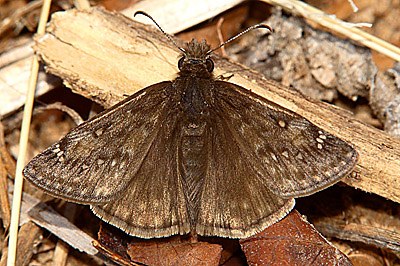
Juvenal's Duskywing is a medium to fairly large duskywing, measuring 1 1/4 to nearly 2 inches across the wings, among the bigger members of its group. Like other duskywings, its coloring is a study in mottled browns and grays, patterned to resemble a dead leaf or bit of bark rather than displaying bold contrasting markings, an effective camouflage for a butterfly that spends much of its time perched on twigs and tree bark rather than in open flight. The wings are broad and rounded compared with some of the narrower-winged duskywings, and, as in other skippers, the antennae end in a hooked, rather than club-shaped tip. At rest it typically holds its wings flat and outspread rather than folded vertically over the back, another feature shared broadly across the skipper family.
This species is closely tied to oak woods and scrub, along with the edges and adjoining fields where oak stands meet more open terrain. It rarely strays far from habitats with oak cover, since its caterpillar host plants are exclusively tree and shrub oaks, and adults tend to stay within flying distance of these woods even while visiting nectar sources in adjacent open ground.
Caterpillars feed exclusively on tree and shrub oaks, chewing and folding a leaf into a shelter in typical duskywing fashion before pupating. Adults nectar at winter cress, dandelion, wild plum, wisteria, blueberry, Carolina vetch, redbud, and lilac, a nectar list dominated by plants that flower in early spring. This timing lines up closely with the species' single annual flight, which runs from April into June; because both the adult flight period and its preferred nectar sources are concentrated in spring, the two appear to be closely synchronized, with adults emerging just as their food plants come into bloom.
Males establish perches roughly 3 to 12 feet up on bare twigs within woodland clearings, a favored vantage point from which they watch for and dart out toward passing females or intruding males, then return to the same perch, a patrolling-from-a-perch strategy that combines the energy savings of waiting with the reach of active pursuit. Individual adult longevity is not well recorded for this species, but since it flies in a single generation each spring, individual adults likely survive only a few weeks, enough time to mate and lay eggs before the flight period ends. Woodland edges and clearings within or near oak stands are the best places to look for this species during its spring flight.
Frequently asked questions
What habitat should I search for Juvenal's Duskywing?
Oak woods and scrub, along with the edges and fields bordering them, since its caterpillars feed exclusively on oaks.
When does Juvenal's Duskywing fly?
It has a single generation each year, flying from April through June.
How do males of this species find mates?
Males perch 3 to 12 feet up on bare twigs in clearings and patrol out from that perch toward passing females or intruders.
What flowers do adult Juvenal's Duskywings visit?
Winter cress, dandelion, wild plum, wisteria, blueberry, Carolina vetch, redbud, and lilac — mostly early-spring bloomers that match its spring flight period.
Where to find it
This species favors forest habitat. See real Oklahoma locations on the Habitats map.