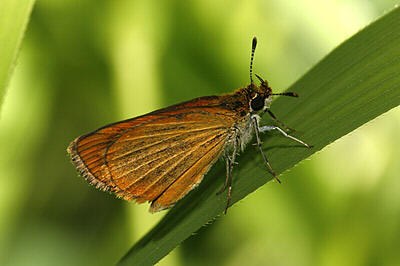
Least Skipper
- Habitat
- Moist/wet open places: tall grasses, marshes, ditches, slow streams, hillsides, old fields
- Size
- 7/8–1 1/8 in (2.2–2.9 cm)
- Lifespan
- As one of the smallest skippers, individuals likely live under two weeks, though this isn't well documented.
- Diet
- Caterpillar: grasses — marsh millet, rice cutgrass, cultivated rice. Adult: wood sorrel, swamp verbena, pickerelweed, chicory, white clover
About the Least Skipper
The Least Skipper lives up to its name as one of the smallest skippers in the region, measuring only about 7/8 to 1 1/8 inches (2.2 to 2.9 cm) across the wings. Its diminutive size, combined with a weak, low, fluttery flight that stays close to grass stems rather than rising into open air, makes it easy to overlook or dismiss as a moth at first glance. As with other skippers, it rests with its wings held in the typical angled posture, and its small size and rounded wing shape give it a somewhat delicate look compared to the larger, more robust grass skippers sharing its habitat. Males use that same low, weaving flight through grass as a mate-locating strategy, patrolling likely breeding sites rather than perching and waiting, a behavior that seems well suited to searching dense grass stands where a perched male might be hard for a passing female to spot.
This species favors moist to wet open places: tall grasses, marshes, ditches, slow-moving streams, hillsides, and old fields. Such damp, grass-dominated ground supplies both the host grasses larvae need and a humid microclimate that likely benefits the small caterpillars and the low-flying adults alike. Because so much of its required habitat is tied to standing or slow water, this skipper tends to be patchily but reliably distributed wherever wet meadows, ditch banks, and marsh edges persist.
Caterpillars feed on grasses, including marsh millet, rice cutgrass, and cultivated rice, host choices consistent with the species' preference for damp ground where these grasses grow densely. Adults nectar at a modest but varied list of flowers: wood sorrel, swamp verbena, pickerelweed, chicory, and white clover, generally landing directly on the flower head and probing with the proboscis in the manner typical of small skippers, which often favor flowers close to ground level given their limited flight height.
A notable and well-documented behavior for this species is that third- and fourth-stage (instar) caterpillars overwinter, entering a dormant hibernation period rather than developing straight through to adulthood before winter arrives, a strategy that lets the species synchronize adult emergence with the return of warm weather and blooming host plants. Because it is among the smallest skippers, individual adults likely live under two weeks, though this specific point has not been well documented in the literature, consistent with the general pattern of short adult lifespans among small grass skippers.
Frequently asked questions
How big is the Least Skipper?
It is one of the smallest skippers, measuring only about 7/8 to 1 1/8 inches (2.2 to 2.9 cm) across the wings.
What kind of habitat does the Least Skipper prefer?
It favors moist to wet open places such as tall grasses, marshes, ditches, slow streams, hillsides, and old fields.
What do Least Skipper caterpillars eat?
Caterpillars feed on grasses including marsh millet, rice cutgrass, and cultivated rice.
How does the Least Skipper survive winter?
Third- and fourth-stage (instar) caterpillars hibernate over winter, resuming development when warm weather returns.
Where to find it
This species favors wetland habitat. See real Oklahoma locations on the Habitats map.