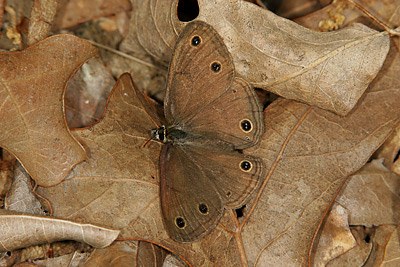
Little Wood Satyr
- Habitat
- Grassy woods and openings, old fields; especially limey/basic soils
- Size
- 1½–1⅞ in (3.8–4.8 cm)
- Lifespan
- Adults typically live about one to two weeks.
- Diet
- Caterpillar: orchard grass, centipede grass. Adult: sap, aphid honeydew, rarely flower nectar
About the Little Wood Satyr
The Little Wood Satyr is a soft brown butterfly, 1½ to 1⅝ inches across, easily identified by two prominent, yellow-ringed eyespots on each wing, a pattern bold enough to make this otherwise subtly colored species one of the more recognizable satyrs in its range. The eyespots likely serve to deflect predator strikes toward the wing margins and away from the body, a common defensive strategy among butterflies that carry this kind of marking.
This species favors grassy woods and clearings, old fields, and habitat edges, and it shows a particular affinity for limey or basic soils, where the grasses it depends on tend to grow most vigorously. That soil preference makes it a useful indicator of certain woodland-edge plant communities, and it is often one of the first satyrs to appear in open, grassy woodland in late spring.
Little Wood Satyrs have a distinctive daily rhythm: they bask with wings spread open during the cooler hours of early morning and late afternoon, soaking up available sunlight to warm their flight muscles, then become more active as temperatures rise. Males patrol shaded areas in search of females using a slow, bouncing flight pattern that can nonetheless carry them up to treetop height, an unexpectedly vertical range for a butterfly that spends most of its time near the ground.
Caterpillars feed on orchard grass and centipede grass, blending in among the blades as they grow through their larval stages. Adults have a broader diet than many related satyrs: alongside tree sap, they regularly feed on aphid honeydew, the sugary secretion produced by aphids feeding on plant sap, and only rarely turn to flower nectar. Adult Little Wood Satyrs typically live about one to two weeks, a short span that is compensated for by a flight period timed to overlap with the peak availability of both their larval host grasses and their preferred adult food sources.
The species appears in a fairly compressed flight period, typically emerging in late spring and remaining on the wing into summer, with some populations in the South producing a partial second brood later in the season. It is often confused with other similarly patterned satyrs where their ranges overlap, though its larger size and the pair of prominent eyespots on each wing usually settle the identification.
Recent genetic research has raised the possibility that what field guides have long treated as a single, widespread Little Wood Satyr may actually represent two or three very similar cryptic species overlapping across parts of the range, distinguishable mainly through subtle differences in flight timing and genetics rather than obvious wing pattern, though this work is still being refined and most observers in the field continue to treat all of them as one species. Predators of the caterpillars and adults likely include birds, ants, and small ambush spiders, and the prominent eyespots on the wings probably function largely as decoys, drawing an attacking bird's strike toward an expendable patch of wing rather than the vulnerable body. Males search for females using a slow, low, bouncing flight through shaded woodland edges and openings, occasionally rising to survey territory from greater height before dropping back down to continue the search near ground level. Because the species relies on common pasture and lawn grasses such as orchard grass, it can persist even in fairly disturbed or mowed woodland edges, provided some unmowed grassy structure remains available for the caterpillars to complete their development, making it one of the more resilient satyrs in landscapes altered by regular human activity.
Frequently asked questions
How can I recognize a Little Wood Satyr?
Look for its brown wings marked with two prominent, yellow-ringed eyespots on each wing.
When is the best time to see Little Wood Satyrs basking?
Early morning and late afternoon, when they open their wings fully to soak up available sunlight.
What do Little Wood Satyr caterpillars eat?
Orchard grass and centipede grass.
What habitat do Little Wood Satyrs prefer?
Grassy woods, openings, and old fields, particularly on limey or basic soils.
Is the Little Wood Satyr actually more than one species?
Recent genetic research suggests it may represent two or three very similar cryptic species, though this is still being studied and most field observers continue to treat it as one.
Where to find it
This species favors grassland habitat. See real Oklahoma locations on the Habitats map.