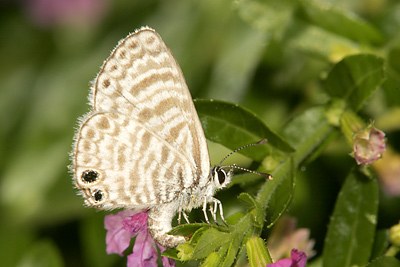
Marine Blue
- Habitat
- Subtropical/southwestern open areas: mesquite scrub, city gardens, desert, alfalfa fields, waste areas
- Size
- 7/8–1⅛ in (2.2–2.9 cm)
- Lifespan
- Adults are very short-lived, typically only around 4 to 10 days.
- Diet
- Host: leadwort and legumes — alfalfa, milkvetch, mesquite. Nectar: flower nectar (unspecified)
About the Marine Blue
The Marine Blue is a small butterfly, ⅞ to 1⅛ inches across, with males showing a soft blue upperside and a distinctive underside marked with fine brown-and-white striping that has earned comparisons to a zebra pattern. Females are duller, with more brown scaling muting the blue, making the sexes noticeably different in overall impression at a glance, though both share the same fine striping pattern below once seen up close.
This species is characteristic of subtropical and southwestern open habitats, including mesquite scrub, city gardens, desert edges, alfalfa fields, and other disturbed or waste ground. It ranges through the southwestern United States and into Mexico, with numbers that can build noticeably during warm months as populations expand outward from core desert and subtropical habitat, occasionally reaching well into the interior of neighboring states before cooler weather sets back the northern edge of its range.
Caterpillars feed on leadwort and various legumes, including alfalfa, milkvetch, and mesquite, and rather than eating leaves, they specialize on flowers and developing seedpods of these host plants. Adults visit flowers for nectar, though the specific plant sources used have not been extensively documented for this species.
Males patrol open habitat searching for females rather than waiting in a fixed spot, and once mated, females lay their eggs singly on flower buds, positioning the next generation directly on the food their caterpillars will need. This flower-and-seedpod diet is common among the small blues profiled here and likely reflects an evolutionary strategy that favors nutrient-rich reproductive plant tissue over less nutritious leaves. Adults are extremely short-lived, typically surviving only about four to ten days, one of the briefest adult lifespans among the butterflies covered in this reference. Because individual generations turn over so quickly, the Marine Blue can produce numerous overlapping broods across a warm season, allowing populations to build rapidly wherever host plants are abundant, particularly after rain triggers a flush of new legume growth in otherwise dry habitat. This boom-and-bust population pattern is common among small blues native to arid and semi-arid parts of the Southwest, where breeding conditions can shift from favorable to marginal within just a few weeks.
The Marine Blue can be confused with the similarly small Ceraunus Blue where the two overlap, and separating them usually depends on close attention to the fine striping pattern and the number and arrangement of small eyespots on the hindwing underside rather than any difference visible at a glance in the field. Predators of the caterpillars likely include ants, small parasitoid wasps, and various birds, though the caterpillars' habit of feeding hidden inside developing flower buds and seedpods probably affords some protection compared with species whose larvae feed exposed on open leaf surfaces. Because its legume host plants respond so quickly to rainfall in arid and semi-arid habitat, Marine Blue populations are thought to track precipitation closely, with a good rainy season triggering a flush of new alfalfa, milkvetch, or mesquite growth that can support several rapid, overlapping generations before drier conditions set back the population again. Males search actively for mates during the day, and courtship appears to rely on a combination of visual approach and close-range chemical cues typical of small lycaenid blues generally, though the specific details have not been closely studied in this particular species. Because so little has been published specifically about adult nectar preferences in this species, careful field notes on exactly which flowers a feeding Marine Blue visits remain a genuinely useful contribution for local naturalists to make.
Frequently asked questions
How can you recognize a Marine Blue?
Males show a soft blue upperside with a finely striped brown-and-white underside pattern, sometimes described as zebra-like.
What do Marine Blue caterpillars eat?
They feed on the flowers and seedpods of leadwort and legumes such as alfalfa, milkvetch, and mesquite.
How long do adult Marine Blues live?
Only about four to ten days, one of the shortest adult lifespans among North American butterflies.
Where do females lay their eggs?
Singly on flower buds of the host plant, positioning caterpillars directly on their food source.
What other blue butterfly is similar to the Marine Blue?
The Ceraunus Blue is similarly small and can be confused with it; the two are best separated by differences in the fine striping and eyespot pattern on the hindwing underside.
Where to find it
This species favors grassland habitat. See real Oklahoma locations on the Habitats map.