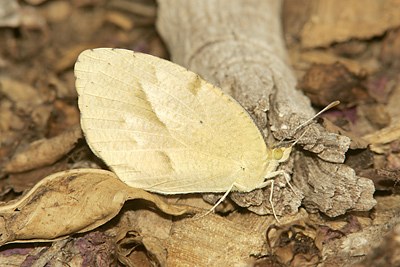
Mexican Yellow
- Habitat
- Open, dry areas; moister regions in Mexico/Central America
- Size
- 1¾–2½ in (4.4–6.3 cm)
- Lifespan
- Precise adult lifespan isn't well documented, likely a few weeks as in related sulphur species.
- Diet
- Host: Acacia and Diphysa (pea family). Nectar: wide variety of flowers
About the Mexican Yellow
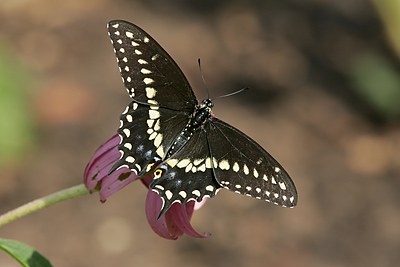
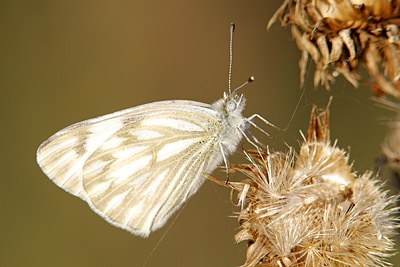
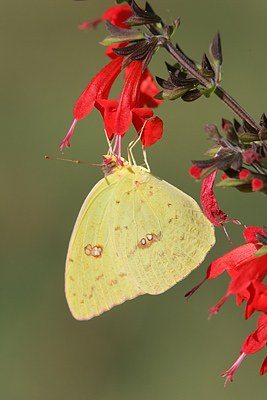
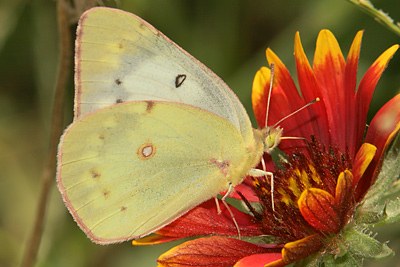
The Mexican Yellow is a striking sulphur named for its color rather than any single distinguishing pattern, though its most memorable feature is a "dog's head" design traced in black along the creamy white forewing, a marking more sharply defined in males than in females. Ranging from 1¾ to 2½ inches, it has an elongated, somewhat angular wing shape with a pointed forewing tip, giving it a leaner silhouette than the rounder sulphurs found farther north, and the underside of the hindwing often shows a subtle mottled texture that helps it blend into dry, sun-bleached vegetation when at rest.
Its core range lies in open, dry country stretching from the southwestern United States through Mexico and into Central America, where wetter regions support denser, more continuously breeding populations. North of this resident range, the Mexican Yellow behaves largely as a vagrant, appearing unpredictably in Texas, Arizona, and occasionally farther afield when population booms or favorable conditions push individuals outward from their normal territory, only to disappear again once temperatures drop, meaning any given sighting well outside the core range likely represents a single stray individual rather than an established local colony.
Caterpillars feed on Acacia and Diphysa, both members of the pea family, plants that are themselves characteristic of the dry thorn-scrub habitats this butterfly favors. Adults are far less selective, nectaring at a wide variety of flowers wherever they can find them, which helps sustain the species through the irregular, boom-and-bust conditions of arid and semi-arid landscapes.
Because the Mexican Yellow is primarily a species of Mexico and Central America, much of what is documented about it comes from populations well south of the Oklahoma region, and its precise adult lifespan has not been closely studied, though it is presumably similar to the few weeks typical of related sulphur species. Its populations in the resident range appear to fly across multiple overlapping generations rather than following a single tightly synchronized brood, allowing it to take advantage of favorable rains whenever they occur. For observers farther north, seeing this butterfly at all is often a matter of timing a visit to coincide with one of its periodic northward pushes, which tend to be concentrated in the warmer months when conditions are most favorable for a long-distance flight away from its home range.
Frequently asked questions
What is the black "dog's head" pattern on this butterfly?
It is a black-bordered marking on the creamy white forewing that resembles a dog's head in profile, more clearly outlined in males than females.
Is the Mexican Yellow common in Oklahoma?
No, it is primarily a resident of Mexico and Central America and only appears as an occasional vagrant farther north.
What do the caterpillars eat?
They feed on Acacia and Diphysa, both pea-family plants typical of the dry habitats this species prefers.
Why do sightings of this butterfly seem so unpredictable?
Populations fluctuate with rainfall and conditions in its home range, and individuals only stray northward periodically rather than on a fixed schedule.
Where to find it
This species favors grassland habitat. See real Oklahoma locations on the Habitats map.