Monarch
Danaus plexippus
- Habitat
- Many open habitats — fields, meadows, weedy areas, marshes, roadsides
- Size
- 3⅜–4⅞ in (8.6–12.4 cm)
- Lifespan
- Summer adults live 2 to 6 weeks, but the non-breeding migratory "super generation" can live 6 to 9 months.
- Diet
- Adults: nectar from milkweeds; early season dogbane, lilac, red clover, lantana, thistles; fall: goldenrods, blazing stars, ironweed, tickseed sunflower
About the Monarch
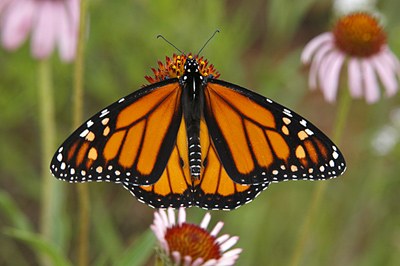
Perhaps no butterfly in North America is more instantly recognizable than the Monarch, with its bold orange wings crossed by thick black veins and bordered by wide black margins dotted with white spots. The sexes are subtly different: males show a burnt-orange color with crisp black veining and a small black scent patch on each hindwing, while females tend toward a slightly darker, more orange-brown hue with heavier, blurred-looking black veins and no scent patches. At 3⅜ to 4⅞ inches across, Monarchs are large, strong fliers, easily spotted gliding over open ground on stiff, shallow wingbeats.
Monarchs turn up almost anywhere there's open habitat — fields, meadows, weedy roadsides, marshes — because their needs are simple: milkweed for the caterpillars and a steady supply of nectar for the adults. Females lay eggs exclusively on milkweed species, the only plants their caterpillars can eat, and the toxic compounds the larvae absorb from milkweed sap stay with them into adulthood, making the butterflies distasteful to most birds. Adult Monarchs are far less picky about nectar, visiting milkweed, dogbane, lilac, red clover, and lantana earlier in the season, then shifting to goldenrods, blazing stars, ironweed, and tickseed sunflower as fall approaches — a shift that conveniently tracks the blooming of these plants along their migration route.
That migration is the Monarch's most extraordinary trait. Beginning in August and continuing through October, millions of Monarchs abandon their breeding grounds across the U.S. and Canada and fly south, some covering well over a thousand miles, to overwintering sites in the mountains of central Mexico. There they cluster by the thousands on individual trees, whole branches sagging under the weight of roosting butterflies, conserving energy through the winter before starting the journey north again in spring.
This migratory lifestyle is tied to a remarkable difference in adult lifespan. Monarchs that emerge and breed during the busy summer months live only about two to six weeks. But the individuals that emerge in late summer are biologically different — a non-reproductive "super generation" that delays maturity, builds up fat reserves, and can live six to nine months, long enough to migrate south, overwinter, and begin the return flight before finally breeding.
Frequently asked questions
How do you tell a male Monarch from a female?
Males have thinner, crisper black wing veins and a small black scent patch on each hindwing, while females show thicker, blurred-looking veins and no scent patch.
Why do Monarch caterpillars only eat milkweed?
Milkweed is the sole host plant for their caterpillars, and the toxic compounds they ingest from it make both the caterpillars and adult butterflies unpalatable to predators.
Where do Monarchs go for the winter?
The fall generation migrates thousands of miles south to overwintering sites in the mountain forests of central Mexico, where they roost together in dense tree clusters.
Why do some Monarchs live so much longer than others?
Summer-breeding adults live only 2 to 6 weeks, but the late-summer 'super generation' that migrates south delays reproduction and can survive 6 to 9 months.
Where to find it
This species favors grassland habitat. See real Oklahoma locations on the Habitats map.