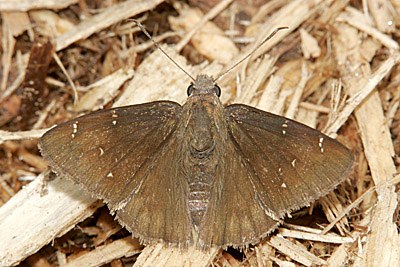
Northern Cloudywing
- Habitat
- Open/scrubby boreal woodland and forest edges
- Size
- 1 1/4–1 7/8 in (3.2–4.7 cm)
- Lifespan
- Adult longevity isn't specifically documented; likely similar to other cloudywings at a few weeks.
- Diet
- Caterpillar: Fabaceae. Adult: dogbane, selfheal, crown vetch, honeysuckle, thistles, milkweed, Deptford pink, hoary vervain
About the Northern Cloudywing
The Northern Cloudywing is a medium-sized skipper measuring roughly 1 1/4 to 1 7/8 inches across the wings, with a dark brown, largely unmarked upperside typical of the cloudywing group. The underside is more informative for identification: a soft brown-gray ground color crossed by two darker, ragged-edged bands on the hindwing, a pattern that helps separate it from similarly drab duskywings and other cloudywing species. Males carry a costal fold along the leading edge of the forewing, a fold of tissue lined with specialized scent scales used to disperse pheromones during courtship, a feature that can help distinguish the sexes in hand or in a clear photograph.
This species favors open and scrubby boreal woodland along with the sunny edges and clearings that border denser forest. Rather than deep forest interior, it seeks the transitional habitat where low legume host plants and nectar sources can flourish in the light gaps created by trails, power-line cuts, and natural openings.
Caterpillars feed on plants in the pea family (Fabaceae), a host relationship shared with many of its cloudywing and duskywing relatives. Adults, by contrast, are opportunistic generalist nectar feeders, drawing from a wide variety of blooming plants, including dogbane, selfheal, crown vetch, honeysuckle, thistles, milkweed, Deptford pink, and hoary vervain. This broad palette suggests the species simply visits whatever suitable flowers are in bloom within its scrubby-edge habitat rather than specializing on one or two nectar plants.
The most distinctive aspect of this species' documented natural history is its mate-locating strategy. Males stake out perches at or near ground level within small forest openings and clearings, releasing pheromones from the scent scales of their costal fold to attract passing females, a passive perch-and-wait approach rather than active patrolling flight over long distances. As with other skippers whose caterpillars feed on broad-leaved plants, the larvae of this species likely construct a shelter by folding or tying together a leaf of the host plant with silk, a common protective strategy across the skipper family that shields the caterpillar from predators and weather between feeding bouts, ultimately pupating within or near this shelter before the adult emerges. Adult lifespan has not been specifically documented for this species, but it is likely comparable to other cloudywings, on the order of a few weeks, consistent with a single flight period rather than a long-lived adult stage. Butterfly-watchers exploring boreal forest edges, clearings, and scrubby trailsides are the most likely observers to encounter this inconspicuous, ground-perching skipper.
Frequently asked questions
How can you tell a Northern Cloudywing from similar duskywings?
Check the underside of the hindwing — it shows two darker, ragged-edged bands on a brown-gray background, a pattern that distinguishes it from similarly drab duskywings.
Where does the Northern Cloudywing live?
It favors open and scrubby boreal woodland along with sunny forest edges and clearings, rather than dense forest interior.
What do Northern Cloudywing caterpillars eat?
They feed on plants in the pea family (Fabaceae), a host relationship typical of cloudywings and duskywings generally.
How do male Northern Cloudywings find mates?
Males perch at or near ground level in small forest openings, using scent scales in a forewing costal fold to release pheromones while waiting for females to pass.
Where to find it
This species favors forest habitat. See real Oklahoma locations on the Habitats map.