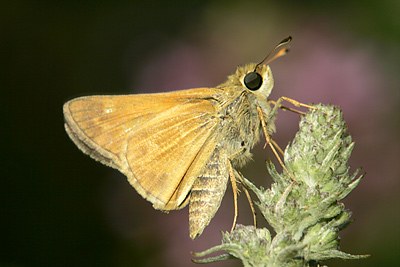
Ottoe Skipper
- Habitat
- Native tall-grass prairie
- Size
- 1 1/4–1 11/16 in (3.2–4.3 cm)
- Lifespan
- Specific data is lacking for this prairie specialist; expect a brief adult life of a few weeks.
- Diet
- Caterpillar: fall witchgrass, little bluestem, other grasses. Adult: green/common milkweed, prickly pear, vetch, alfalfa, bush houstonia, coneflower, leadplant, compassplant, sunflower, blazing star
About the Ottoe Skipper
The Ottoe Skipper is a robust prairie species, measuring roughly 1 1/4 to 1 11/16 inches (3.2 to 4.3 cm) across the wings, placing it among the larger grass skippers found on the tallgrass prairie. Adults show a bright brownish-orange upperside, with females typically appearing even brighter than males, a reversal of the usual pattern in many skippers where males carry the bolder coloring. As with other skippers, it holds its wings at an angle when perched, and observers describe it as a strong, confident flier, capable of covering open prairie ground quickly rather than fluttering weakly through vegetation the way some of the smaller grass skippers do.
This species is a genuine prairie specialist, restricted to native tall-grass prairie rather than the disturbed fields, roadsides, and lawns that more generalist skippers tolerate. That narrow habitat requirement makes the Ottoe Skipper a useful indicator of prairie quality, since it depends on intact native grassland rather than the mowed or non-native grass stands where many other skippers thrive; its populations tend to track the health and extent of remaining tallgrass prairie fragments. As tallgrass prairie has become one of the most reduced native habitat types in North America, species like this one are increasingly confined to scattered remnant parcels rather than continuous range.
Caterpillars feed on native prairie grasses, including fall witchgrass, little bluestem, and other grasses typical of the tallgrass community. Adults draw nectar from an especially wide range of prairie forbs: green and common milkweed, prickly pear, vetch, alfalfa, bush houstonia, coneflower, leadplant, compassplant, sunflower, and blazing star, a list that reads almost like an inventory of tallgrass prairie wildflowers. This broad nectar diet likely reflects the general pattern among strong-flying prairie skippers, which can travel further between blooms and so are less dependent on any single flower species, landing on the flower head with wings often partly open to bask while feeding.
Males employ a perch-based mating strategy, stationing themselves near host plants for the entire day and waiting for receptive females to appear rather than patrolling widely, an approach that conserves energy while keeping the male close to the grasses where females are likely to arrive to lay eggs. Specific longevity data are lacking for this prairie specialist, but a brief adult life of a few weeks fits the general pattern for grass skippers, meaning the persistence of the species over time depends heavily on the caterpillars' access to undisturbed native grasses across successive years, underscoring why intact prairie habitat matters so much to its survival.
Frequently asked questions
What habitat does the Ottoe Skipper require?
It is a prairie specialist restricted to native tall-grass prairie.
What color are Ottoe Skipper adults?
They have a bright brownish-orange upperside, with females typically appearing even brighter than males.
What plants do Ottoe Skipper caterpillars feed on?
Caterpillars feed on fall witchgrass, little bluestem, and other native prairie grasses.
How do male Ottoe Skippers seek mates?
Males perch near host plants all day, waiting for females to appear, rather than patrolling widely.
Where to find it
This species favors grassland habitat. See real Oklahoma locations on the Habitats map.