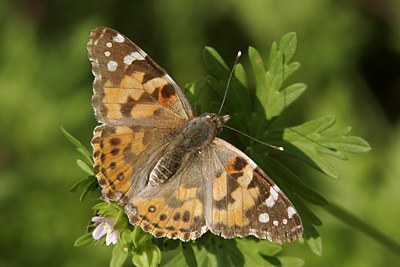
Painted Lady
- Habitat
- Almost everywhere, especially open/disturbed areas: gardens, old fields, dunes
- Size
- 2–2⅞ in (5.1–7.3 cm)
- Lifespan
- Adults generally live 2 to 4 weeks, sometimes longer while actively migrating.
- Diet
- Caterpillar: 100+ host plants including thistles, hollyhock, mallow, legumes. Adult: prefers thistles/tall composites, also aster, cosmos, blazing star, ironweed, joe-pye weed, red clover, buttonbush, privet, milkweeds
About the Painted Lady
The Painted Lady (Vanessa cardui) is a medium to large brushfoot, spanning 2 to 2⅞ inches, with an upperside of orange and black in an irregular checkered pattern and a row of white spots near the black forewing tip. The underside hindwing carries a band of four small eyespots, a useful mark for separating it from the two-eyespot American Lady. Overall coloring tends toward rosy-orange rather than the deeper tawny tones of some relatives, and the wings have a somewhat mottled, marbled underside that provides camouflage at rest.
Few butterflies are as widely distributed: the Painted Lady turns up in almost any open or disturbed habitat, from backyard gardens and old fields to coastal dunes, roadsides, and farmland. It is often called the Cosmopolitan for its presence on every continent except Antarctica and Australia, and in North America it is best known for periodic mass migrations northward out of the deserts of northern Mexico into the United States and Canada, with numbers varying enormously from year to year.
Caterpillars are famously unfussy, recorded feeding on more than 100 different host plants, with thistles, hollyhock, and mallow among the favorites, along with various legumes. Adults are equally opportunistic nectar feeders but show a clear preference for thistles and other tall composite flowers, also visiting aster, cosmos, blazing star, ironweed, joe-pye weed, red clover, buttonbush, privet, and milkweeds.
Like its relatives, the male Painted Lady stakes out an afternoon territory, perching and patrolling to intercept females. Adults usually live two to four weeks, sometimes longer during an active migratory push. Unlike the American Lady, the Painted Lady generally cannot survive winter as far north as much of its breeding range and hibernates only in the South or during unusually mild winters, meaning northern populations are largely reestablished each year by fresh arrivals from the south.
Population size varies enormously from year to year, driven largely by rainfall patterns in the desert regions of northern Mexico where the species breeds through winter. A wet winter there can trigger an explosive population boom and a correspondingly massive spring migration north, producing occasional years when the species seems to be everywhere at once before numbers settle back down.
The Painted Lady can be confused with both the American Lady and the West Coast Lady where their ranges overlap, and while the American Lady's two large hindwing eyespots offer the clearest distinction, separating the Painted Lady from the West Coast Lady often comes down to subtler differences in the exact color and pattern of the forewing tip. Recent tracking studies using radar and other technology have shown that migrating Painted Ladies can fly at surprising altitudes and cover very long distances in a single generation, taking advantage of favorable winds to travel far beyond what the butterflies could achieve through their own flight power alone, though the full details of how individuals navigate and time these movements are still being worked out by researchers. Predators of the caterpillars and adults include birds, various ambush spiders, and parasitoid wasps and flies, and mass migratory years likely see heavier-than-usual losses to predators simply because so many individuals are moving through unfamiliar territory at once. Males establish afternoon territories and defend them against rival males while watching for passing females, a strategy typical of many Vanessa species and one that concentrates mating activity around a relatively small number of favored perch sites within any given patch of habitat.
Frequently asked questions
Why is the Painted Lady called the Cosmopolitan butterfly?
It has one of the widest distributions of any butterfly in the world, found on nearly every continent except Antarctica and Australia.
What plants do Painted Lady caterpillars eat?
They are extreme generalists with over 100 recorded host plants, favoring thistles, hollyhock, mallow, and various legumes.
Do Painted Ladies migrate?
Yes, they migrate northward out of northern Mexico into the United States and Canada, with population booms in some years.
Can Painted Ladies survive northern winters?
Generally not; they typically only hibernate as adults in the South or in unusually mild winters, so northern populations rely on migration each year.
How is the Painted Lady different from the similar American Lady?
The American Lady shows two large eyespots on the hindwing underside, compared with the Painted Lady's band of four smaller eyespots, the most reliable way to tell the two apart.
Where to find it
This species favors grassland habitat. See real Oklahoma locations on the Habitats map.