Pearl Crescent
- Habitat
- Open areas: pastures, road edges, vacant lots, fields, open pine woods
- Size
- 1¼–1¾ in (3.2–4.5 cm)
- Lifespan
- Adults typically live around two weeks, one of the better-studied crescent species.
- Diet
- Caterpillar: smooth-leaved asters. Adult: dogbane, swamp milkweed, shepherd's needle, asters, winter cress
About the Pearl Crescent
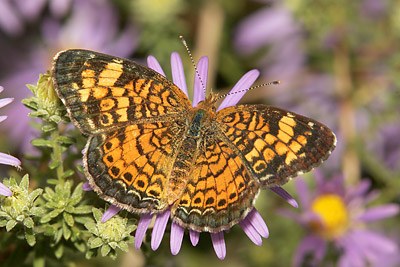
The Pearl Crescent (Phyciodes tharos) is a small, orange butterfly measuring 1¼ to 1¾ inches (3.2–4.5 cm) across the wings, with a bold black checkered pattern overlaying the orange ground color. A distinctive dark crescent mark sits along the margin of the hindwing underside, the feature that gives the species its name, though the exact pattern can vary somewhat across its wide range and multiple generations. It is among the most frequently seen small butterflies in eastern North America, in part because it tolerates such a broad range of open habitats.
Pearl Crescents turn up almost anywhere with open, sunny ground: pastures, road edges, vacant lots, fields, and even open pine woods. Caterpillars feed exclusively on smooth-leaved asters, a widespread group of wildflowers that ensures the species rarely has to search far for a place to lay eggs. Adults are considerably less selective, nectaring at dogbane, swamp milkweed, shepherd's needle, various asters, and winter cress, giving them a long list of nectar sources across the growing season.
Males patrol open areas rather than perching and waiting, actively searching out females across fields and road edges. After mating, females lay their eggs in small batches on the undersides of aster leaves, and the caterpillars that hatch are gregarious in their early instars, feeding together before dispersing to feed independently as they grow. As autumn approaches, development pauses: the caterpillar reaches its third instar and overwinters in that state, tucked into leaf litter or similar shelter, before resuming growth the following spring.
Adults typically live around two weeks, and because the species produces multiple generations each year across most of its range, Pearl Crescents can be found on the wing from spring through fall almost anywhere open, aster-rich ground exists. It is one of the better-studied crescent species, thanks largely to how common and widespread it is, making it a useful benchmark for understanding the biology of its less-studied relatives.
Male and female Pearl Crescents differ subtly in appearance: males tend toward a brighter orange with less black marking, while females and late-season individuals often show heavier black patterning, especially near the forewing tip. The species produces several broods each year across most of its range, as many as three in warmer regions, which is part of why it remains one of the most frequently spotted small butterflies in eastern North America from spring clear through fall.
Frequently asked questions
Why is it called the Pearl Crescent?
It's named for the crescent-shaped mark along the margin of the hindwing underside.
Where is the Pearl Crescent commonly found?
In open habitats such as pastures, road edges, vacant lots, fields, and open pine woods across much of eastern North America.
What do Pearl Crescent caterpillars eat, and how do they survive winter?
They feed on smooth-leaved asters, and in autumn they pause development in their third instar to overwinter before resuming growth in spring.
How long do adult Pearl Crescents live?
Adults typically live around two weeks, one of the better-documented lifespans among crescent species.
Where to find it
This species favors grassland habitat. See real Oklahoma locations on the Habitats map.