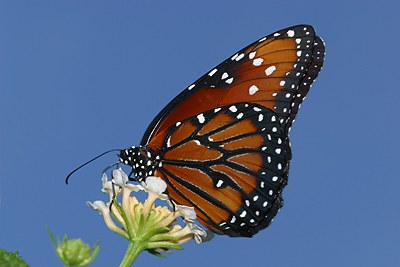
Queen
- Habitat
- Open, sunny areas: fields, deserts, roadsides, pastures, dunes, washes, waterways
- Size
- 2⅝–3⅞ in (6.7–9.8 cm)
- Lifespan
- Like its monarch relative, breeding-season adults live roughly 2-5 weeks, while non-reproductive individuals can survive several months.
- Diet
- Caterpillar: milkweeds and milkweed vines. Adult: nectar from milkweeds, fogfruit, shepherd's needle
About the Queen
The Queen is often mistaken at a glance for its more famous relative, the Monarch, but a closer look reveals a butterfly with its own distinct look. Queens run a bit smaller, at 2⅝ to 3⅞ inches across, and wear a deeper, richer chestnut-brown to mahogany-orange rather than the Monarch's brighter orange. Their black wing borders are narrower, and rather than the Monarch's crisp black venation, Queens show scattered white spots across both the upper and lower wing surfaces, especially noticeable on the forewing tips and along the hindwing margins. In flight, the resemblance to Monarchs is strong enough that both species likely benefit from shared protection against predators that have learned to avoid the pattern.
Queens favor open, sun-baked country across the warmer parts of North America — fields, deserts, roadsides, pastures, sand dunes, desert washes, and the vegetation lining waterways. This preference for arid and semi-arid habitat reflects the plants they depend on: like Monarchs, Queen caterpillars feed exclusively on milkweeds and milkweed vines, many of which thrive in the dry, open conditions the adults frequent. Females distribute their eggs one at a time on the leaves, stems, or flower buds of host plants rather than laying in clusters, spreading the risk of predation across many individual sites.
As with Monarchs, the milkweed diet does double duty for Queens: it fuels caterpillar growth and it loads the insect's tissues with cardiac glycosides, bitter and mildly toxic compounds that make both larvae and adults distasteful to birds and other predators. Adult Queens continue to draw nectar from milkweed flowers alongside fogfruit and shepherd's needle, plants common in the open, disturbed habitats they favor.
Queens also show a notable social streak uncommon among many butterflies: outside of active mating and feeding, adults often roost together communally overnight or during poor weather, clustering on vegetation in numbers. During the day, males patrol continuously in search of receptive females rather than waiting at a fixed perch. Lifespan follows the same pattern seen in Monarchs — breeding-season adults typically live only two to five weeks, while individuals that aren't actively reproducing can persist for several months.
Male Queens, like Monarchs and other milkweed butterflies, possess specialized scent structures called hairpencils near the tip of the abdomen, which they extend and brush against a female during courtship to disperse pheromones that help convince her to accept mating, a behavior documented across the milkweed butterfly subfamily more broadly. While the milkweed diet renders most Queens distasteful enough to deter experienced birds, young caterpillars and eggs have not yet built up the same level of protection as older larvae and adults, leaving these early stages considerably more vulnerable to predation and to parasitoid wasps and flies that specialize on milkweed-feeding butterflies. Although Queens are far less famous for migration than Monarchs, populations in parts of the Southwest do show at least a partial seasonal shift, moving into and out of certain areas as temperatures and host plant availability change through the year, though nothing resembling the Monarch's directed, continent-scale migration to a handful of overwintering sites has been documented for this species. Because Queens and Monarchs overlap broadly in range, diet, and toxic chemistry, the two species are sometimes considered co-models in the same predator-avoidance system, with naive birds that sample either species likely learning to avoid both going forward.
Frequently asked questions
How is a Queen butterfly different from a Monarch?
Queens are smaller and darker, with a deep chestnut-orange color, narrower black borders, and scattered white spots rather than the Monarch's crisp black-veined pattern.
Why are Queens unpalatable to predators?
Their caterpillars feed exclusively on milkweed, and the cardiac glycosides absorbed from that diet make both larvae and adults bitter-tasting and mildly toxic to would-be predators.
Where are Queens typically found?
They favor open, sunny, often arid habitats such as deserts, fields, dunes, washes, and roadsides, generally in warmer parts of North America.
Do Queens roost in groups like Monarchs?
Yes, adults commonly roost communally overnight or in bad weather, clustering together on vegetation.
Do Queens migrate the way Monarchs do?
Not to the same degree; while some populations shift seasonally with temperature and host plant availability, Queens don't undertake anything like the Monarch's directed, continent-scale migration to specific overwintering sites.
Where to find it
This species favors grassland habitat. See real Oklahoma locations on the Habitats map.