Reakirt's Blue
- Habitat
- Grasslands, fields, desert, meadows, weedy areas, creek sides
- Size
- ¾–1⅛ in (2–2.9 cm)
- Lifespan
- Like most small blues, adults likely survive only about a week; exact species data isn't well documented.
- Diet
- Host: pea family — yellow sweet clover, rattleweed, mesquite, indigo bush, mimosa. Nectar: spearmint, white sweet clover, among other herbs
About the Reakirt's Blue
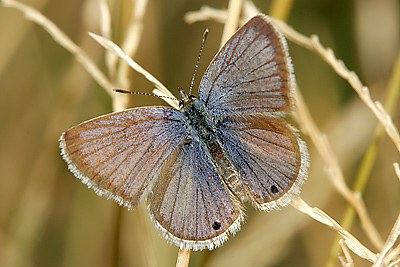
Reakirt's Blue is a small butterfly, ¾ to 1⅛ inches across, with males showing blue uppersides bordered in dark scaling and females appearing more brownish blue overall. The underside is pale gray-brown and marked with distinctive large black spots ringed in white, most noticeably near the base of the hindwing, a pattern that serves as a useful field mark separating it from other small blues in the same habitats, since the eyespot is considerably larger and bolder than the markings found on look-alike species like the Eastern Tailed-Blue.
This species occurs across grasslands, fields, deserts, meadows, weedy areas, and creek sides, largely in the southwestern and south-central United States. Its wide tolerance for dry, open, and disturbed ground allows it to occupy a broad range of habitats within that general region, and like several other small blues it can also stray or colonize temporarily well outside this core area during favorable years.
Caterpillars feed on pea-family plants, including yellow sweet clover, rattleweed, mesquite, indigo bush, and mimosa, while adults nectar at flowers such as spearmint and white sweet clover, among other herbs. This diet overlaps with several other small blues profiled here, reflecting the pea family's importance as a host resource across this whole group of butterflies.
Males fly erratically during the day as they search for mates, a flight pattern that distinguishes them from species that patrol more steadily or simply perch and wait. Females lay their eggs singly on flower buds, typically at midday, and the resulting caterpillars are tended by ants while they feed on flowers and seedpods, a mutualistic relationship in which the ants protect the caterpillars from predators and parasites in exchange for sugary secretions the caterpillars produce. This ant association, called myrmecophily, is common among blues in the family Lycaenidae and likely improves caterpillar survival substantially. Like most small blues, adult Reakirt's Blues probably survive only about a week, though precise lifespan data specific to this species remains limited, with most of what is documented about its biology coming from its interactions with host plants and attendant ants rather than from tracking individual adults.
Reakirt's Blue can be confused with both the Marine Blue and the Ceraunus Blue where their ranges overlap in the Southwest, and confirming an identification usually comes down to the size and boldness of the white-ringed black spot near the hindwing base, which is notably larger and more prominent in Reakirt's Blue than in either of those similar species. Beyond the well-documented ant attendance of the caterpillars, predators of this species likely include birds and small ambush spiders, though the mutualism with tending ants probably reduces losses to at least some of these threats during the vulnerable caterpillar stage. Like the Marine Blue, Reakirt's Blue is capable of substantial seasonal range expansion, with individuals straying well north of the core southwestern and south-central breeding range during warm months before retreating or dying out as cooler weather returns, a pattern common among small blues whose caterpillars depend on legumes that themselves respond quickly to seasonal rainfall. Courtship likely involves a combination of visual approach and close-range pheromone cues typical of small lycaenid blues, and because females lay eggs directly on flower buds at midday, much of the mating and egg-laying activity for this species is concentrated into the warmest part of the day rather than spread evenly across daylight hours.
Frequently asked questions
How do you identify a Reakirt's Blue?
Look for large black spots ringed in white on the pale gray-brown underside, especially near the base of the hindwing.
Why are the caterpillars often seen with ants nearby?
Ants tend the caterpillars in a mutualistic relationship, protecting them from predators in exchange for sugary secretions, a behavior called myrmecophily.
When do females lay their eggs?
Typically at midday, laying eggs singly on flower buds of the host plant.
How long do adults typically live?
Likely only about a week, similar to most other small blues, though exact data for this species is limited.
How far can Reakirt's Blue range beyond its core habitat?
It can stray considerably north of its core southwestern and south-central range during warm months, similar to the Marine Blue, before retreating or dying out when cooler weather returns.
Where to find it
This species favors grassland habitat. See real Oklahoma locations on the Habitats map.