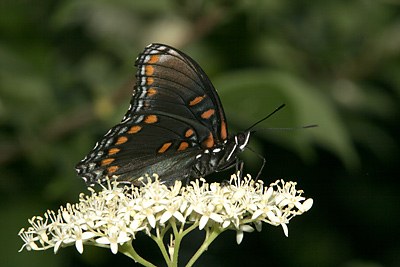
Red-spotted Purple
- Habitat
- Deciduous/mixed forests, moist uplands, valley bottoms, coastal plains
- Size
- 2¼–4 in (5.7–10.1 cm)
- Lifespan
- Adults typically live 2 to 3 weeks; this species overwinters as a caterpillar, not as an adult.
- Diet
- Caterpillar: wild cherry, aspen, poplar, cottonwood, oaks, hawthorn, deerberry, birch, willows, basswood, shadbush. Adult: sap flows, rotting fruit, carrion, dung, occasionally nectar
About the Red-spotted Purple
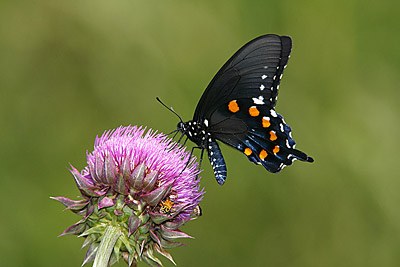
The Red-spotted Purple (Limenitis arthemis astyanax) is a large, richly colored butterfly, 2¼ to 4 inches across, with wings that appear black at a glance but shimmer with iridescent blue-green across the hindwing when caught in sunlight. The underside shows a scattering of orange-red spots near the wing margins, giving the species its name, and it lacks the white band found on its northern relative the White Admiral, with which it forms a single interbreeding species showing two very different-looking forms. Even the caterpillars carry their own disguise: mottled in shades of olive, cream, and brown with a humped, warty profile, a resting larva looks remarkably like a small twisted bit of bird droppings or a curled dead leaf clinging to a twig, one of the more convincing camouflage tricks among eastern butterfly larvae.
This butterfly is a creature of the forest, favoring deciduous and mixed woodlands, moist upland slopes, valley bottoms, and coastal plain woods, generally sticking closer to wooded edges, trails, and clearings than to open meadows or the deep, closed-canopy forest interior. Its range covers much of the eastern and central United States, generally replaced by the white-banded form farther north into Canada and New England, with a broad zone of intermediate individuals where the two forms meet and interbreed, a hybrid zone that appears to shift somewhat from year to year depending on local weather and host-plant conditions.
Caterpillars feed on the leaves of a wide range of woody trees and shrubs, including wild cherry, aspen, poplar, cottonwood, various oaks, hawthorn, deerberry, birch, willows, basswood, and shadbush, giving them considerably more host-plant flexibility than many specialist butterflies, a trait that likely helps the species maintain healthy populations even where any single host tree is scarce. Adults rarely bother with flower nectar, instead favoring sap flows, rotting fruit, carrion, and dung as their primary food sources, only occasionally turning to blossoms; males in particular are frequent visitors to muddy roadsides and damp soil, where they take up dissolved minerals and salts, a behavior known as puddling that is thought to supply nutrients useful in reproduction.
Males typically perch high in the forest canopy rather than patrolling for mates, making them easier to spot flying past at treetop height than resting low, though they will readily descend to investigate a puddling spot, a fallen fruit, or a sap flow lower down. Females lay their eggs singly on host leaves, and rather than passing winter as an adult or a chrysalis, the species overwinters as a partially grown, third-stage caterpillar tucked into a curled leaf shelter called a hibernaculum, resuming feeding and development the following spring. Adults themselves live only about two to three weeks once they emerge, and bask with wings held flat open to absorb solar warmth on cool mornings, a posture shared with many of its Limenitis relatives.
Its dark, iridescent blue-black coloring is thought to be a case of Batesian mimicry, closely resembling the foul-tasting Pipevine Swallowtail and thereby gaining some protection from predators that avoid that unpalatable model, even though the Red-spotted Purple itself carries no special chemical defense. This resemblance is largely absent in the white-banded form of the same species found farther north, where Pipevine Swallowtails are scarce or absent, a pattern that offers a tidy real-world example of how mimicry can appear, fade, or shift in strength depending on whether the toxic model it depends on is locally common.
Frequently asked questions
Is the Red-spotted Purple related to the White Admiral?
Yes, they are the same species with two very different-looking forms, and the two interbreed where their ranges overlap.
What do Red-spotted Purple caterpillars eat?
They feed on a wide variety of trees and shrubs, including wild cherry, aspen, poplar, cottonwood, oaks, hawthorn, birch, and willows.
Do Red-spotted Purples visit flowers?
Rarely; adults mainly feed on sap flows, rotting fruit, carrion, and dung rather than nectar.
How does the Red-spotted Purple survive winter?
It overwinters as a partly grown caterpillar rather than as an adult or chrysalis, sheltering in a curled leaf until spring.
Why do male Red-spotted Purples gather at mud puddles?
They are puddling, drawing up minerals and salts from damp soil that likely aid in reproduction, a behavior common among butterflies but especially noticeable in this species.
Where to find it
This species favors forest habitat. See real Oklahoma locations on the Habitats map.