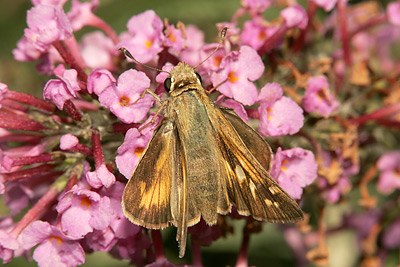
Sachem
- Habitat
- Disturbed open areas: roadsides, landfills, pastures, meadows, fencerows, yards, parks, lawns
- Size
- 1 1/4–1 5/8 in (3.2–4.2 cm)
- Lifespan
- This common, multi-brooded skipper's adults are generally observed living about one to two weeks.
- Diet
- Caterpillar: Bermuda grass, crabgrass, St. Augustine grass, goosegrass. Adult: milkweeds, buttonbush, dogbane, peppermint, red clover, tickseed sunflower, thistles, ironweed, marigold, asters
About the Sachem
The Sachem is a fairly large skipper, measuring roughly 1 1/4 to 1 5/8 inches across, and one of the more sexually dimorphic species in the family. Males show a bright yellow-orange ground color broken by a wide brown border and a bold, squarish black stigma across the forewing, while females are more subdued, marked chiefly by a translucent white spot near the center of the forewing that shows through when the wing is held to the light. This difference is pronounced enough that the two sexes can look almost like separate species to an inexperienced observer, and worn or faded individuals of either sex can further complicate quick identification in the field.
This is a butterfly of disturbed, open ground almost everywhere it occurs, turning up along roadsides, in landfills, pastures, meadows, fencerows, yards, parks, and lawns, a habitat list that reads like a survey of the most heavily human-altered landscapes available. That tolerance, combined with multiple broods each year, makes it one of the most frequently seen skippers across much of its range, since new generations of adults are on the wing repeatedly through the warm season rather than emerging in a single narrow window.
Caterpillars feed on common turf and pasture grasses, including Bermuda grass, crabgrass, St. Augustine grass, and goosegrass, all species that thrive in exactly the mowed and grazed settings the adults favor, which helps explain why the Sachem does so well in suburban and agricultural landscapes rather than requiring intact native habitat. Adults nectar widely and opportunistically at milkweeds, buttonbush, dogbane, peppermint, red clover, tickseed sunflower, thistles, ironweed, marigold, and asters, an unusually broad list spanning wild forbs and garden plantings alike, letting adults find food virtually anywhere flowers bloom.
Males spend most of the day perched on or near bare ground rather than patrolling in flight, watching for passing females from a fixed vantage point, a low-energy mating strategy well suited to a species that must fit multiple generations into a single season. Perching also allows males to bask, angling their wings toward the sun to raise body temperature and stay flight-ready to intercept rivals or receptive females, a common thermoregulation tactic among ground-perching skippers in open, sun-exposed habitat. As a common, multi-brooded skipper, individual adults are generally observed living only about one to two weeks, a short lifespan offset by the frequency of new broods emerging throughout the warmer months, which keeps adults present in the landscape almost continuously rather than in one brief annual flight.
Frequently asked questions
How can you tell male and female Sachems apart?
Males are yellow-orange with a wide brown border and a large black stigma, while females show a translucent white forewing spot instead.
What habitats does the Sachem prefer?
It favors disturbed open areas like roadsides, landfills, pastures, meadows, fencerows, yards, parks, and lawns.
What plants do Sachem caterpillars and adults use?
Caterpillars feed on lawn and pasture grasses like Bermuda grass and crabgrass, while adults nectar at milkweeds, thistles, asters, and many other flowers.
Why is the Sachem so commonly seen?
It is multi-brooded, producing repeated generations through the warm season, and adults typically live about one to two weeks each.
Where to find it
This species favors grassland habitat. See real Oklahoma locations on the Habitats map.