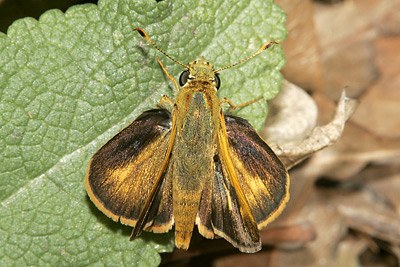
Southern Broken-Dash
- Habitat
- Openings near wooded rivers or swamps
- Size
- 1–1 3/8 in (2.4–3.5 cm)
- Lifespan
- Adult longevity hasn't been specifically recorded; assume the usual few-week skipper lifespan.
- Diet
- Caterpillar: Paspalum, St. Augustine grass. Adult: pickerelweed, selfheal, sweet pepperbush
About the Southern Broken-Dash
The Southern Broken-Dash is a medium skipper, spanning about 1 to 1 3/8 inches, best identified by the male's distinctive stigma, a scent-producing patch of specialized androconial scales on the forewing that appears visually split into two segments, earning the species its "broken dash" name. These stigmas function in courtship, releasing pheromones during close encounters with females that help trigger mating behavior, a mate-recognition system used widely across skippers where visual wing patterns alone can be too similar between related species to reliably signal identity. Females lack the stigma and can appear more uniformly marked, which occasionally complicates field identification when the diagnostic mark on a male is worn or held at an awkward angle.
This species is tied closely to openings near wooded rivers and swamps, favoring the sunlit edges and clearings that form where forest canopy breaks along waterways rather than deep shade or fully open prairie. That habitat preference reflects the moisture needs of its host grasses and the shelter such semi-wooded edges provide from wind and extreme temperature swings, conditions that let both larvae and adults persist through the hotter parts of the season. As with many riparian-corridor insects, populations likely shift along these narrow bands of habitat as water levels and canopy cover change from year to year, making the species somewhat patchier in distribution than more generalist skippers of open grassland.
Caterpillars feed on Paspalum and St. Augustine grass, and notably carry a piece of cut leaf material with them while feeding, a portable shield thought to offer some camouflage or physical protection from predators and parasitoids while the caterpillar is exposed and vulnerable, a behavior documented in relatively few skipper species and one of the more distinctive natural-history notes for this butterfly. Adults nectar at pickerelweed, selfheal, and sweet pepperbush, all plants tied to the same moist, semi-shaded habitats the species favors, suggesting adults do not need to travel far from larval habitat to find sufficient nectar sources through their flight period.
Males perch low, generally within about 2 feet of the ground, and are most active in early morning hours, a perch-and-wait mating strategy that lets them conserve energy while watching for receptive females passing through the same sunlit openings favored by the whole species. Adult longevity has not been specifically studied for this skipper, so the usual assumption of a few-week adult lifespan, typical across the skipper family generally, is presumed to apply here as well.
Frequently asked questions
What is the "broken dash" in the Southern Broken-Dash's name?
It refers to the male's forewing stigma, a scent-scale patch that visually appears split into two segments.
Where is the Southern Broken-Dash typically found?
It occurs in openings near wooded rivers or swamps, favoring sunlit edges along waterways rather than open prairie or deep forest.
Do Southern Broken-Dash caterpillars have any unusual behavior?
Yes, they carry a piece of cut leaf material with them while feeding, likely for camouflage or protection.
When are male Southern Broken-Dash skippers most active?
Males perch low, within about 2 feet of the ground, and are most active in early morning hours.
Where to find it
This species favors wetland habitat. See real Oklahoma locations on the Habitats map.