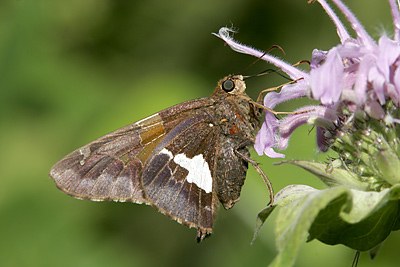
Silver-spotted Skipper
- Habitat
- Disturbed and open woods, foothill streamcourses, prairie waterways
- Size
- 1¾–2⅝ in (4.5–6.7 cm)
- Lifespan
- Adults typically survive one to two weeks in the wild, occasionally longer in favorable conditions.
- Diet
- Caterpillar: woody legumes — black locust, honey locust, false indigo; also herbaceous legumes. Adult: "almost never visits yellow flowers," favors blue/red/pink/purple/white/cream — everlasting pea, common milkweed, red clover, buttonbush, blazing star, thistles
About the Silver-spotted Skipper
The Silver-spotted Skipper is one of the largest and most easily identified skippers in North America, with a wingspan of 1¾ to 2⅝ inches and a stocky, fast-flying build typical of the family. Its dorsal wings are a rich dark brown broken by a large, translucent gold-tan patch across the middle of the forewing, but the field mark that gives the species its name is on the underside: a broad, bright silvery-white band cutting across the hindwing, visible whenever the butterfly perches with wings closed. That silver flash is often the quickest way to confirm an identification, since many brown skippers look alike in flight.
This species turns up in disturbed and open woodland edges, foothill streamcourses, and the brushy margins of prairie waterways, anywhere its woody legume host plants take root. Caterpillars feed on black locust, honey locust, and false indigo, along with various herbaceous legumes, chewing on foliage that is common along the forest edges and successional habitats the species favors. Adults are notably selective nectar feeders with a distinct color bias: they almost never visit yellow flowers, instead favoring blue, red, pink, purple, white, and cream blooms such as everlasting pea, common milkweed, red clover, buttonbush, blazing star, and thistles.
Caterpillar behavior in this species is built around shelter-building. Young larvae fold over a section of a host leaf and fasten it with silk to create a protective tent, retreating inside between feeding bouts. As they grow, older caterpillars upgrade to more substantial silked leaf shelters, effectively building themselves a series of increasingly sturdy hideouts through each developmental stage — a defense against both predators and parasitic wasps that hunt exposed caterpillars.
Adults have their own distinctive resting posture: rather than perching normally, Silver-spotted Skippers often hang upside down beneath leaves at night and during hot or overcast days, presumably to stay hidden and regulate body temperature out of direct sun. When the season winds down, the species overwinters not as an adult or a caterpillar but as a chrysalis, tucked away to wait out the cold before emerging the following year.
This species ranges across most of the United States and southern Canada, tracking the distribution of its woody legume host plants, and it is one of the most widely recognized skippers thanks to its large size and bold silver hindwing patch. Its fast, powerful flight and habit of visiting a wide variety of colorful garden flowers make it a familiar sight even to casual observers who might otherwise overlook smaller, less conspicuous skippers.
Frequently asked questions
Why is it called the Silver-spotted Skipper?
The name comes from the broad, bright silvery-white band that crosses the underside of the hindwing, clearly visible when the butterfly perches with wings folded.
What flowers do Silver-spotted Skippers avoid?
They almost never visit yellow flowers, strongly preferring blue, red, pink, purple, white, or cream blooms instead.
How do the caterpillars protect themselves?
Young caterpillars fold host leaves into shelters, while older caterpillars build more substantial silked leaf retreats to hide in between feeding.
What life stage survives the winter?
The species overwinters as a chrysalis rather than as an adult or caterpillar.
Where to find it
This species favors wetland habitat. See real Oklahoma locations on the Habitats map.