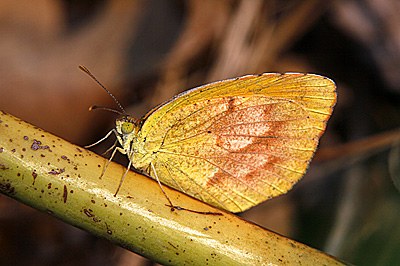
Sleepy Orange
- Habitat
- Low elevation: pine flats, fields, desert scrub, gardens, vacant lots, road edges, washes
- Size
- 1⅜–2¼ in (3.5–5.7 cm)
- Lifespan
- Adults usually live 1 to 2 weeks, but a late-season form can overwinter for months in the South.
- Diet
- Host: Cassia spp. (pea family). Nectar: various flowers including shepherd's needle
About the Sleepy Orange
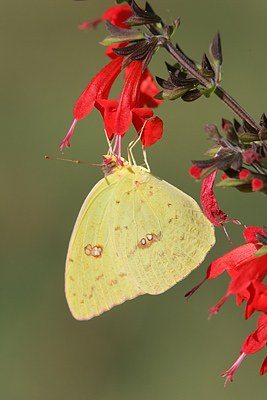
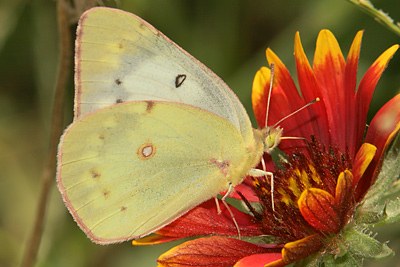
The Sleepy Orange is a small to medium sulphur, 1⅜ to 2¼ inches across, with wings colored a warm orange-yellow and marked by irregular black borders and a dark spot near the center of the forewing. The common name is something of a puzzle to newcomers, since the butterfly is neither slow nor obviously drowsy; it likely refers instead to a small dark mark near the tip of each antenna's club, thought by early namers to resemble a closed or "sleepy" eye, a naming quirk it shares in spirit with the unrelated Sleepy Duskywing skipper. Its coloring shifts seasonally: individuals emerging in cooler months tend to show heavier, darker markings than the brighter, more lightly marked summer form, a pattern called seasonal dimorphism that is common among sulphurs but especially pronounced in this species, likely because the heavier markings offer some thermal or camouflage benefit during cooler weather that lighter-marked summer individuals do not need.
It is a butterfly of low-elevation, open country, found in pine flats, desert scrub, fields, gardens, vacant lots, road edges, and washes across the southern United States and beyond. Because it tolerates a wide range of dry, disturbed habitats, it is often one of the more consistently encountered small sulphurs in the southern half of its range, sometimes gathering in noticeable numbers at damp sand or mud where males take up minerals and moisture, occasionally forming small mixed puddling clubs alongside other sulphurs and swallowtails.
Like other sulphurs, adults can likely perceive ultraviolet patterns on their own wings that are invisible to human eyes, a detail thought to help members of this butterfly family recognize their own species at close range even when human observers see very similar coloring across several related sulphurs. Caterpillars feed on Cassia and Senna species, plants shared with several other southern sulphurs, and adults nectar at a variety of flowers, including shepherd's needle. The close relationship between this species and its Senna hosts ties its distribution closely to wherever these legumes grow in sufficient abundance, and because several Senna species are also planted ornamentally, the butterfly readily colonizes gardens and landscaped lots well beyond wild habitat.
Males patrol low over flats and through gullies searching for females rather than waiting in one place, and mated females lay their eggs singly on the undersides of host leaves. At rest overnight or during cool weather, Sleepy Oranges typically perch low on grass stems with their wings folded shut, presenting only the drab, cryptic underside to any passing predator rather than the bright orange upperside used mainly in flight and courtship. Most generations live only one to two weeks as adults, but the darker, heavily marked dry-season form that emerges in fall behaves very differently: rather than dying off quickly, it can survive for months through the winter in the southern part of the range, becoming reproductively active again the following spring.
This dual strategy, rapid turnover during the growing season paired with a long-lived overwintering form, lets the Sleepy Orange make the most of both warm and cold seasons within its range, and helps explain why the species can be found on the wing in some part of the southern United States during almost any month of the year.
Beyond its host-plant ties, the Sleepy Orange is also a notably strong flier for its size, capable of covering open ground quickly when disturbed, and like several other southern sulphurs it appears to make loose seasonal movements northward as temperatures warm each spring, helping the species recolonize the northern edge of its range well before Cassia and Senna plants themselves have fully leafed out. Where its range overlaps with other small orange-and-yellow butterflies, careful attention to the dark forewing spot and the border pattern is usually enough to separate a Sleepy Orange from superficially similar species such as the Dainty Sulphur or various small orange skippers glimpsed briefly in flight.
Frequently asked questions
Why does the Sleepy Orange look different at different times of year?
It shows seasonal dimorphism, with cooler-season individuals developing darker, heavier markings than the brighter summer form.
How does this butterfly survive winter in the south?
A darker dry-season form emerges in fall and can live for months, overwintering as an adult and breeding again in spring.
What do Sleepy Orange caterpillars eat?
They feed on Cassia and Senna species, the same pea-family host plants used by several related southern sulphurs.
Where do males look for mates?
They patrol low over open flats and through gullies rather than perching in a fixed spot.
Where does the name "Sleepy Orange" come from?
It likely refers to a small dark mark near the tip of the antenna club that early observers thought resembled a closed, sleepy eye, not any actual sluggishness in the butterfly.
Where to find it
This species favors grassland habitat. See real Oklahoma locations on the Habitats map.