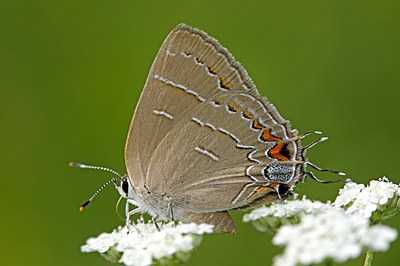
Soapberry Hairstreak
- Habitat
- Desert foothill canyons, prairie valleys, hedgerows, woodlands, roadsides
- Size
- 1–1½ in (2.5–3.8 cm)
- Lifespan
- Adult lifespan isn't well documented for this locally uncommon hairstreak.
- Diet
- Host: western soapberry. Nectar: flower nectar (unspecified sources)
About the Soapberry Hairstreak
The Soapberry Hairstreak is a modestly patterned, gray-brown butterfly measuring 1 to 1½ inches across, with thin tails on the hindwing and a small orange spot near the base of each tail, features typical of hairstreaks generally rather than distinctive to this species alone. It is considered locally uncommon across much of its range, and its comparatively plain coloring means it is easy to overlook among more showily marked hairstreaks sharing the same habitat, so confirming an identification usually requires a careful look at a resting individual rather than a quick glance in flight. Taxonomically, it is the only member of its genus, Phaeostrymon, a reflection of just how tightly its evolutionary history has stayed bound to a single host tree rather than diversifying onto a broader menu of plants the way many hairstreak genera have.
This species is tied specifically to areas where its single host plant grows: desert foothill canyons, prairie valleys, hedgerows, woodlands, and roadsides, generally in the southern Great Plains and adjacent regions. Because its caterpillars depend entirely on one tree species, the butterfly's overall distribution mirrors the somewhat scattered occurrence of that tree across the landscape, and it is essentially absent from otherwise suitable-looking terrain where soapberry does not grow. Where soapberry has been cleared for agriculture or development, local colonies of the hairstreak likely disappear along with it, making the species a modest indicator of intact native tree stands in these regions.
Caterpillars feed exclusively on western soapberry, a tree that gives the species its common name, and this narrow host relationship makes the Soapberry Hairstreak something of a specialist compared to hairstreaks that can use several different plant families. Like many single-host hairstreaks, it appears to fly in a single generation each year, with adults on the wing for a relatively brief window in late spring timed to the availability of fresh soapberry growth, rather than the extended, multi-brood flight season seen in generalist species like the Red-banded Hairstreak. Adults nectar at various flowers, though the specific nectar sources used by this species have not been extensively documented in available records.
Males typically patrol the canopy of soapberry trees searching for mates, staying close to the host plant rather than ranging widely across open ground. After mating, females lay their eggs singly on twigs of the host tree, where the eggs remain through the winter months before hatching the following spring, timed to coincide with the tree's new leaf growth.
Because this species is locally uncommon and has not been the subject of extensive study, detailed information on adult lifespan and precise brood timing remains limited, and much of what is understood about its biology is inferred from its close relationship with soapberry trees rather than from dedicated long-term studies of the butterfly itself. Anyone hoping to find this species is generally better served by locating a stand of western soapberry first and watching it patiently than by searching open habitat at random, ideally timing a visit to coincide with the tree's fresh spring leaf-out when both nectar sources and newly laid eggs are most likely to be present.
Because western soapberry itself is a slow-spreading, somewhat clonal tree that tends to form loose colonies along drainages rather than dense stands, populations of the hairstreak are often patchily distributed even within otherwise suitable-looking country, clustering tightly around the healthiest stands of host trees rather than spreading evenly across the landscape. Observers who find one individual are therefore often rewarded by finding several more nearby, since a single good soapberry grove can support a locally dense colony even where the species is scarce or absent only a short distance away.
Frequently asked questions
What is the only host plant for Soapberry Hairstreak caterpillars?
Western soapberry, a tree that gives this butterfly its common name.
Where would you look for a Soapberry Hairstreak?
In desert foothill canyons, prairie valleys, hedgerows, and woodlands wherever western soapberry trees grow.
When do the eggs hatch?
Eggs are laid singly on twigs in the fall, overwinter there, and hatch the following spring as the host tree leafs out.
How do males find females?
Males patrol the canopy of soapberry trees rather than searching open ground.
Is the Soapberry Hairstreak closely related to other hairstreaks?
It is the only species in its genus, Phaeostrymon, reflecting how tightly its evolution has stayed tied to a single host tree rather than diversifying onto multiple plants.
Where to find it
This species favors grassland habitat. See real Oklahoma locations on the Habitats map.