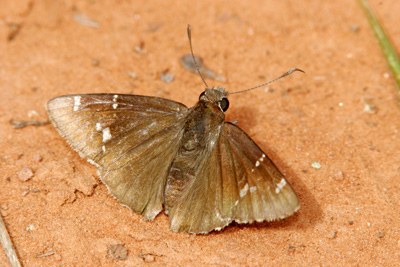
Southern Cloudywing
- Habitat
- Open scrubby places: dry meadows, burned areas, dry prairie hills, powerline right-of-ways
- Size
- 1 5/16–1 7/8 in (3.3–5 cm)
- Lifespan
- No dedicated lifespan studies exist; expect the typical skipper pattern of a couple of weeks.
- Diet
- Caterpillar: pea family — beggar's ticks, bush clover, clover, milkvetch, fuzzybean, wild bean. Adult: blue/purple/pink/white flowers — dogbane, selfheal, crown vetch, honeysuckle, thistles, milkweed
About the Southern Cloudywing
The Southern Cloudywing is a small, dusky-brown skipper measuring roughly 1 5/16 to 1⅞ inches across, named for the softly mottled, "clouded" pattern that washes across its wings rather than any crisp bold markings. Small, faint translucent spots interrupt the forewing, but overall this species reads as a plain, dark butterfly at rest — one that relies more on subtle textural pattern than bright color for its identity, making careful comparison with other cloudywing species important for a confident identification.
This skipper favors open, scrubby, often disturbed ground: dry meadows, recently burned areas, dry prairie hillsides, and the mowed corridors beneath powerline right-of-ways. These sun-exposed, low-vegetation habitats support both its larval host plants and the basking, perching behavior adults rely on. Caterpillars feed on a range of pea-family plants, including beggar's ticks, bush clover, clover, milkvetch, fuzzybean, and wild bean, all common colonizers of the same dry, open ground the adults frequent. Adults nectar at blue, purple, pink, and white flowers such as dogbane, selfheal, crown vetch, honeysuckle, thistles, and milkweed, showing the same preference for cooler-toned blooms seen in several related skipper species.
Male Southern Cloudywings practice a mating strategy known as hilltopping, staking out a perch typically 1.5 to 4.5 feet up on vegetation atop a hill or rise and waiting there for females to pass through. What makes this behavior especially notable is its persistence: some individual males appear to reuse the very same perch for the entirety of their adult lives, returning to it again and again rather than shifting locations, effectively defending one small patch of real estate as their exclusive territory.
Females, in turn, lay their eggs singly on the undersides of host plant leaflets, a strategy that spreads offspring across many individual plants and reduces the risk that a single predator or parasite could wipe out an entire clutch at once. As with most skippers, no dedicated studies have pinned down precise adult lifespan for this species, but it's expected to follow the typical skipper pattern of surviving only a couple of weeks as a flying adult.
The species ranges through the southeastern and south-central United States, generally favoring the same dry, open, disturbed ground that supports its pea-family host plants. Because so many skippers in this group look broadly similar, careful attention to habitat, wing shape, and the pattern of pale forewing spots is often needed to separate the Southern Cloudywing confidently from its close relatives sharing the same range.
Frequently asked questions
Why is it called the Southern Cloudywing?
The name refers to the softly mottled, clouded brown pattern across its wings, rather than any bold or crisp markings.
What plants do Southern Cloudywing caterpillars feed on?
Various pea-family plants, including beggar's ticks, bush clover, clover, milkvetch, fuzzybean, and wild bean.
What is 'hilltopping' behavior in this species?
Males perch on vegetation atop hills or rises, roughly 1.5 to 4.5 feet up, waiting for females — some reportedly reuse the same perch for their entire adult life.
Where would I look to find a Southern Cloudywing?
Open scrubby habitats like dry meadows, recently burned areas, dry prairie hillsides, and powerline right-of-ways.
Where to find it
This species favors grassland habitat. See real Oklahoma locations on the Habitats map.