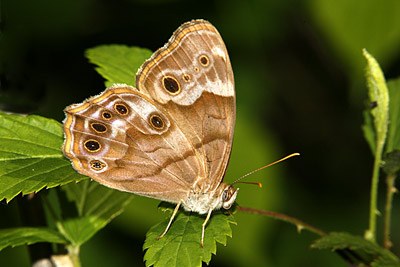
Southern Pearly Eye
- Habitat
- Shady, damp woods near stream-fed swamps
- Size
- 2 3/16–2¾ in (5.6–7 cm)
- Lifespan
- Adult lifespan isn't well documented for this species, but likely one to two weeks like related satyrs.
- Diet
- Caterpillar: bamboo switch cane. Adult: sap, rotting fruit, carrion, dung
About the Southern Pearly Eye
The Southern Pearly Eye is a woodland satyr measuring roughly 2 3/16 to 2¾ inches across, clothed in soft brown with a row of dark, pupiled eyespots along the wing margins that give the species its common name. The eyespots and the subtly wavy wing pattern help break up its outline against dappled shade, and like other satyrs it rarely ventures into bright open sun, instead favoring the low, filtered light of a shaded understory where its coloring works best as camouflage.
This species is a specialist of shady, damp woods near stream-fed swamps, particularly places where its host plant, bamboo switch cane, forms dense understory thickets known as canebrakes. That narrow habitat association makes the Southern Pearly Eye a good indicator of intact, moist bottomland woods, and it is seldom seen far from cane growth. Within these shaded groves it flies with a low, fluttering pattern, often at dawn or dusk when light levels are already dim, rather than during the heat of midday.
Males secure territory by perching on tree trunks, sometimes oriented head-downward, and wait there for females to pass, darting out briefly to investigate intruders before returning to the same perch. Females lay their eggs singly on or near the switch cane rather than in clusters, and the resulting caterpillars feed directly on the cane foliage. Older caterpillars are the ones that carry the species through winter, entering a dormant state until the canebrake resumes growth in spring.
Adults feed on sap, rotting fruit, carrion, and dung rather than flower nectar, foraging opportunistically for these mineral- and sugar-rich resources within their shaded home range. Precise data on adult longevity for this species has not been well studied, but based on closely related satyrs it is thought to be brief, likely on the order of one to two weeks. Because Southern Pearly Eyes are so tied to cane thickets along southern streams, protecting these swampy woodland margins is essential to keeping the species present in a given area.
This species ranges through the southeastern United States, generally staying within a short flight of the shaded canebrakes its caterpillars depend on, and it rarely wanders into more open habitat. Because switch cane thickets have declined in many areas due to land clearing and altered fire regimes, the Southern Pearly Eye's fortunes are closely tied to the health of these increasingly uncommon streamside habitats.
Frequently asked questions
What habitat does the Southern Pearly Eye prefer?
Shady, damp woods near stream-fed swamps, especially areas with cane thickets, and it rarely ventures into open sun.
What is the caterpillar's host plant?
Bamboo switch cane, a native cane species that grows in dense stands along southern waterways.
How do male Southern Pearly Eyes find mates?
They perch on tree trunks, sometimes hanging head-downward, and wait there for females to pass by.
How does this species survive the winter?
Older caterpillars overwinter in a dormant state, resuming feeding and development the following spring.
Where to find it
This species favors wetland habitat. See real Oklahoma locations on the Habitats map.