Southern Skipperling
- Habitat
- Grassy places, open fields, flats
- Size
- 5/8–7/8 in (1.6–2.2 cm) — stated as the smallest North American skipper
- Lifespan
- No specific longevity records exist for this tiny species; a short one-to-two-week life is likely.
- Diet
- Caterpillar: Bermuda grass. Adult: fine-leaved sneezeweed
About the Southern Skipperling
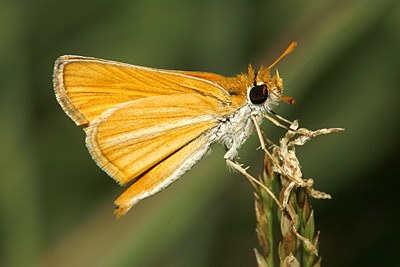
The Southern Skipperling holds the distinction of being the smallest skipper in North America, with a wingspan of only about 5/8 to 7/8 inch (1.6 to 2.2 cm), smaller even than most other diminutive grass skippers. Both wing surfaces are a pale orange, giving the insect a soft, washed-out look rather than the bolder orange-and-black contrast seen in many larger skippers. The underside of the hindwing carries a distinctive white stripe running from the wing base all the way to the outer margin, a clean field mark that helps separate this species from other small pale skippers sharing its range. Males can be distinguished by a narrow black mark on the forewing, a scent-scale stigma used in courtship signaling, while females lack it; as with related species, this stigma likely disperses pheromones during close encounters with potential mates rather than serving any visual signaling role at a distance. Like its relative the Fiery Skipper, with which it shares a genus, it has the characteristic thick body, large head, and whirring, fast, low flight typical of grass skippers generally.
This tiny skipper favors grassy places, open fields, and flats, unassuming, sunlit ground with a low, dense grass layer rather than tall prairie or woodland edge. Given its size, it likely stays close to the ground throughout its life, both because such a small insect has limited flight range and because the low grass canopy offers cover from wind and predators alike. Its habitat preferences overlap broadly with those of other small grass skippers, though its extremely small size and pale coloring make it easy to miss even where it is locally common; observers often first notice it as little more than a fleck of orange bouncing low over bare, grassy ground before it settles long enough to be identified.
Caterpillars feed on Bermuda grass, a widespread, tough, low-growing turf grass that tolerates mowing, grazing, and heat, traits that likely make it a dependable and abundant host across the skipperling's range, including lawns, roadsides, and pastures where the grass is deliberately planted or has become naturalized. Because Bermuda grass grows and regrows through most of the warm season, the species likely produces several overlapping generations per year across the southern part of its range, keeping fresh adults on the wing from spring well into fall. Adults nectar primarily at fine-leaved sneezeweed, perching on the flower heads and probing with the proboscis in the manner typical of small skippers, which tend to favor flowers held close to the ground given their limited flight height and modest size.
No specific longevity records exist for this tiny species, but given its size and its close relationship to other short-lived grass skippers, a brief one-to-two-week adult life is a reasonable expectation. As with many small skippers whose caterpillars feed on tough, resilient grasses like Bermuda grass, the larval stage is likely the more resilient part of the life cycle, sheltering within folded or tied grass blades, held together with silk, while the adult stage focuses its brief existence on feeding and reproduction. This grass-blade shelter likely also affords some protection from parasitoid wasps and flies that hunt more exposed caterpillars, though detailed studies of natural enemies specific to this species are lacking.
Because it is so small, pale, and fast-flying, the Southern Skipperling is one of the more challenging Oklahoma butterflies to confirm by sight alone, and many observers rely on a combination of habitat, size, and a good look at the underside hindwing stripe rather than a fleeting view in flight. Patience pays off here more than with almost any other skipper on this list: waiting near a patch of blooming sneezeweed in appropriate short-grass habitat is generally far more productive than trying to chase down individuals in flight.
Frequently asked questions
Is the Southern Skipperling really the smallest skipper?
Yes, it is documented as the smallest skipper in North America, with a wingspan of only about 5/8 to 7/8 inch (1.6 to 2.2 cm).
How can you identify a Southern Skipperling?
It has pale orange wings on both surfaces, a white stripe running from base to margin on the underside hindwing, and males show a narrow black forewing mark.
What does the Southern Skipperling caterpillar eat?
The caterpillars feed on Bermuda grass.
What flowers do Southern Skipperling adults nectar at?
Adults nectar primarily at fine-leaved sneezeweed.
Why is it so easy to overlook this species?
Its extremely small size, pale washed-out color, and fast low flight over short grass make it easy to mistake for blowing debris rather than a butterfly.
Where to find it
This species favors grassland habitat. See real Oklahoma locations on the Habitats map.