Tawny-edged Skipper
- Habitat
- Moist grassy areas: prairie swales, pastures, lawns, roadsides, vacant lots
- Size
- 7/8–1 7/16 in (2.2–3.6 cm)
- Lifespan
- No dedicated studies exist; adults probably live a typical skipper span of one to two weeks.
- Diet
- Caterpillar: panic grasses, slender crabgrass, bluegrass. Adult: alfalfa, red clover, dogbane, shrub houstonia, coneflower, thistles, chicory
About the Tawny-edged Skipper
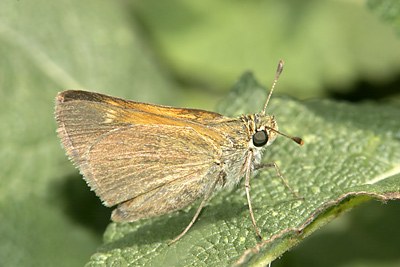
The Tawny-edged Skipper is a small, dark-winged skipper measuring roughly 7/8 to 1 7/16 inches across, with a dusky brown upperside broken by patches of orange along the leading edge of the forewing. That orange marking, more extensive in males than in females, gives the species its common name and is usually the quickest field mark to check, though worn individuals can look almost uniformly dark. Like most skippers, it holds its wings in the characteristic triangular, jet-fighter posture at rest, wings folded at differing angles rather than flat like a typical butterfly or fully closed like a moth, an adaptation thought to aid both camouflage and rapid thermoregulation on cool mornings.
This species favors moist, grassy habitats with a distinctly disturbed or semi-open character: prairie swales, pastures, lawns, roadsides, and vacant lots all support populations, reflecting its tolerance for mowed or grazed turf as long as some grass is left to seed and grow. It is consequently one of the more commonly encountered skippers across its range, unbothered by disturbance that pushes out habitat specialists. Males are territorial and perch rather than patrol, staking out spots in grassy valley bottoms or low swales where they wait for passing females, a strategy that conserves energy compared with constant flight and lets the male rely on quick reflexes to intercept anything that flies through his chosen airspace. Perching males also spend considerable time basking with wings partly spread to absorb warmth, a common thermoregulation behavior among skippers that boosts flight-muscle temperature before a territorial chase.
Caterpillars feed on a range of grasses, including panic grasses, slender crabgrass, and bluegrass, all fine-bladed hosts typical of skipper larvae, which generally build shelters by tying blades together with silk and feeding from within, safely hidden from predators between meals. Adults are considerably less picky, nectaring at alfalfa, red clover, dogbane, shrub houstonia, coneflower, thistles, and chicory, a broad diet across wildflowers and legumes that lets them exploit whatever is blooming in disturbed ground through the season.
No dedicated longevity studies exist for this species, so adults are presumed to live a typical skipper span of one to two weeks, consistent with the short adult lifespans documented across the family. The chrysalis is the overwintering stage, tucked low in grass or leaf litter through the cold months and emerging the following season, a strategy shared by many grass-feeding skippers whose caterpillars pupate before winter rather than continuing to feed. This timing means adults are generally on the wing only during the warmer months, synchronized with the grasses their caterpillars depend on.
Frequently asked questions
How do you identify a Tawny-edged Skipper?
Look for a dark brown upperside with orange patches along the forewing's leading edge, more extensive in males; it measures about 7/8 to 1 7/16 inches across.
Where does the Tawny-edged Skipper live?
It favors moist grassy habitats such as prairie swales, pastures, lawns, roadsides, and vacant lots, tolerating disturbed and mowed ground well.
What do Tawny-edged Skipper caterpillars eat?
Caterpillars feed on panic grasses, slender crabgrass, and bluegrass, while adults nectar at alfalfa, red clover, dogbane, and thistles among others.
How does the Tawny-edged Skipper overwinter?
It overwinters as a chrysalis, and adults likely live only about one to two weeks like most skippers.
Where to find it
This species favors grassland habitat. See real Oklahoma locations on the Habitats map.