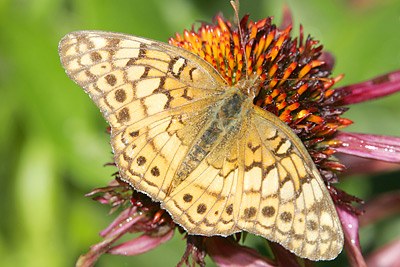
Variegated Fritillary
- Habitat
- Open, moist fields, valleys, pastures, meadows, open woodland, prairies
- Size
- 1¾–3⅛ in (4.5–8 cm)
- Lifespan
- Adults typically live a few weeks, similar to other fritillary species.
- Diet
- Caterpillar: various violets. Adult: milkweeds, thistles, ironweed, dogbane, mountain laurel, verbena, vetch, bergamot, red clover, joe-pye weed, purple coneflower
About the Variegated Fritillary
The Variegated Fritillary is a mid-sized butterfly, 1¾ to 3⅛ inches across, with an orange-brown upperside broken up by an intricate mottled, checkered pattern rather than the simple black spotting typical of many fritillaries. Its underside lacks the large silver spots found on true silver-spotted fritillaries, showing instead a more subdued mottled brown and tan pattern, a key feature that distinguishes it from close relatives like the Great Spangled Fritillary, and its wings are also noticeably more angular and elongated than the rounder-winged Speyeria fritillaries. Even its chrysalis is distinctive: a smooth, pale case dotted with metallic gold or silvery spots, shiny enough to catch passing light, one of the more ornamental pupal forms among North American butterflies and a small reward for anyone lucky enough to find one hanging beneath a leaf.
This species occupies open, moist fields, valleys, pastures, meadows, open woodland, and prairies, and it ranges much more widely across North America than many true fritillaries, in part because it is a strong disperser capable of colonizing new territory well beyond its core breeding range each year, regularly showing up as a temporary summer resident far north of where it can survive the winter, occasionally straying as far as southern Canada in years with favorable winds and weather.
Caterpillars feed on various violets, along with passionflower and stonecrop reported in some parts of its range, while adults nectar at an unusually broad list of flowers, including milkweeds, thistles, ironweed, dogbane, mountain laurel, verbena, vetch, bergamot, red clover, joe-pye weed, and purple coneflower, reflecting a generalist feeding strategy that likely helps this species establish itself quickly in newly colonized areas. The caterpillar itself is boldly marked, with alternating orange and white stripes along a body studded with branching black spines, a warning-style pattern that may discourage some predators even though the species is not known to sequester specific plant toxins the way Monarchs do from milkweed.
Males search open habitat for females rather than perching, and females lay their eggs near host violets in late summer. The newly hatched caterpillars then enter a dormant state for winter without having fed extensively, resuming activity the following spring to eat young violet leaves as they emerge. Unlike the true Speyeria fritillaries, which are typically restricted to a single generation per year, the Variegated Fritillary can produce multiple broods across a season in warmer regions, contributing to its wider distribution and its tendency to appear as a colonist well north of where it can reliably overwinter.
Adults typically live a few weeks, comparable to other fritillary species, and the overlapping broods mean fresh individuals keep appearing throughout the flight season rather than all emerging in one synchronized pulse. This continuous breeding, paired with strong dispersal ability, is a major reason the Variegated Fritillary turns up so much more widely and unpredictably than its more habitat-bound Speyeria relatives, and it is often one of the first fritillary-type butterflies to recolonize disturbed or recently cleared ground.
Because of its long flight season and broad nectar preferences, the Variegated Fritillary is also one of the more frequently observed pollinators at late-summer wildflower plantings and native prairie restorations, visiting composite flowers such as coneflower and ironweed alongside bees and other butterflies. At a quick glance in flight it is sometimes mistaken for a fritillary-shaped skipper or even a worn Gulf Fritillary, but its checkered, angular wings and comparatively erratic, low flight path usually resolve the confusion once the butterfly is seen at rest.
Frequently asked questions
How is the Variegated Fritillary different from true silver-spotted fritillaries?
It lacks the large silver spots on the underside that species like the Great Spangled Fritillary display, showing a mottled brown and tan pattern instead.
What do the caterpillars eat?
Mainly various violets, along with passionflower and stonecrop reported in some parts of its range.
How does this species spend the winter?
Newly hatched caterpillars overwinter in a dormant state before feeding on fresh violet leaves the following spring.
Does the Variegated Fritillary produce more than one generation a year?
Yes, it can produce multiple broods per season in warmer areas, unlike many true fritillaries that fly just once a year.
What does the Variegated Fritillary's chrysalis look like?
It is smooth and pale with metallic gold or silvery spots, one of the more ornamental chrysalises among North American butterflies.
Where to find it
This species favors grassland habitat. See real Oklahoma locations on the Habitats map.